
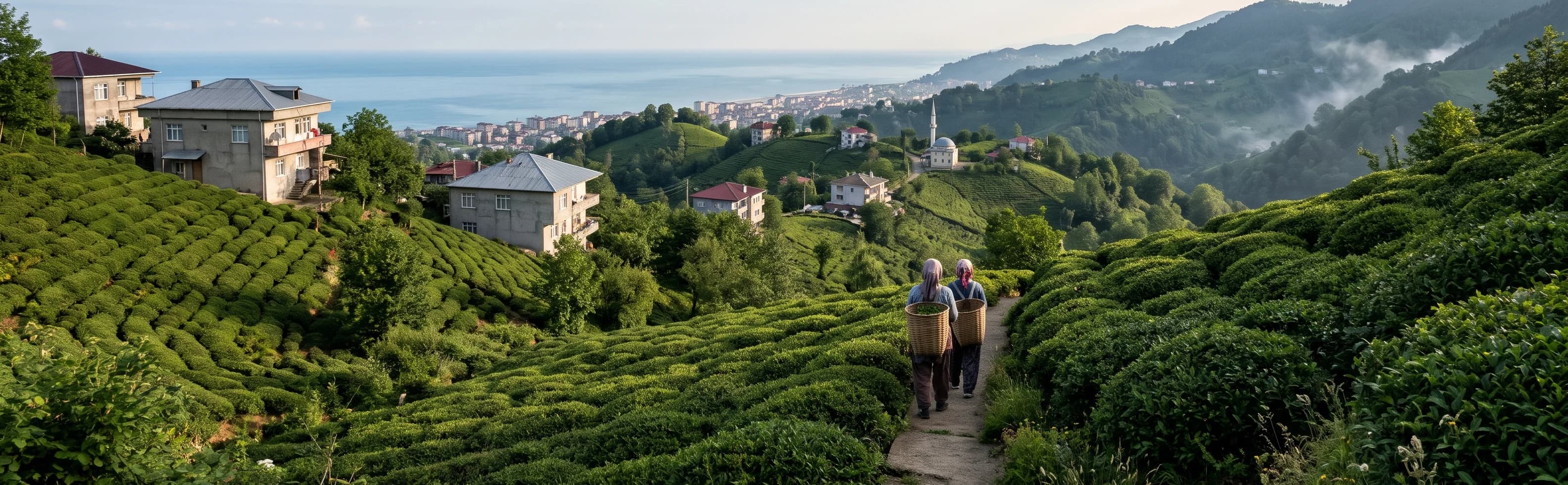
Rize
Rize is a province on Turkey's eastern Black Sea coast, where steep green hillsides covered in tea bushes rise from the shore toward the Kaçkar Mountains. The provincial capital, also called Rize, sits on a narrow strip between the sea and the slopes. Inland, the Fırtına Valley leads past Ottoman stone bridges and the cliff-top castle of Zilkale to Ayder's mountain plateau. This guide covers the tea gardens, the valley, the high pastures, local food, and the best time to plan your trip.
Let the activities begin!
No tours match these filters yet. Try another destination or browse all tours.
The Heart of Turkish Tea
Much of the tea poured in Turkey is grown on these hills, and Rize is the country's largest tea-producing province. Experimental planting began in 1912, the first commercial crop came in 1938, and the first tea factory opened in 1947. Today, the state-owned tea company Çaykur is headquartered in the city and runs dozens of processing factories across the region. Picking usually runs from late spring to October, and in season you will see workers moving along the steep rows. A few family-run plantations in the hills welcome visitors who want to try picking for themselves.
Tea here is served the Turkish way: in small, tulip-shaped glasses, either strong and dark (demli) or weak and light (açık), with sugar cubes on the side. Shopkeepers, office staff, and village families will often offer you a glass.
Rize City
The provincial capital is a working port town, not a resort. Climb to the Ziraat Botanical Garden, founded in 1924 on the hillside about two kilometers southwest of the center. There you can sit in the tea garden and look out over the bay and the rooftops. Above the town, the partly ruined medieval Rize Castle offers another wide view of the coast. Back at sea level, the waterfront promenade and the central market are good places to watch daily life and buy loose tea to take home.
The Fırtına Valley
The Fırtına, whose name means "storm" in Turkish, rises in the Kaçkar Mountains and runs 68 kilometers to the Black Sea near Ardeşen. Its valley is the main route into the highlands and one of the province's most scenic drives. From the late seventeenth century, Ottoman builders spanned the river with stone bridges. More than 20 of these bridges survive, and many rise in steep, humpbacked arches over the rushing water. The valley is also known for whitewater rafting and zip lines in the warmer months.
Farther upstream, about 13 kilometers south of the town of Çamlıhemşin, the medieval castle of Zilkale stands on a rocky spur high above the gorge. Its restored shell is surrounded by forest, and the view down to the river is dramatic. In late spring, rhododendrons bloom across the surrounding slopes.
Ayder and the Kaçkar Mountains
Ayder is a plateau village at around 1,350 meters, about 17 kilometers beyond Çamlıhemşin at the end of a side valley. Wooden guesthouses and forested slopes give it an alpine feel, and official records first mention its hot springs in 1871. The government declared Ayder a tourism center in 1987, and it is now the most popular base for exploring the mountains.
Above Ayder rise the Kaçkar Mountains, a glaciated range whose highest point, Kaçkar Dağı, reaches 3,937 meters. The area became a national park in 1994. Its high valleys hold scattered mountain lakes. The best trekking season runs from June to September. Many walkers start with day hikes to the surrounding plateaus, such as Pokut, known for its wooden summer houses and wide views. Longer treks into the range are best done with a local guide, since paths are not always well marked and the weather can change quickly.
Highland Culture
Rize is home to Turkish, Laz, Hemşin, and Georgian communities, and each has left its mark on the region's music, food, and village life. The Hemşin people are closely linked with the districts of Hemşin and Çamlıhemşin in the highlands. In summer, families still move up to the yaylas, the high pastures, as they have for generations. At weddings and festivals, you may see the horon, a fast Black Sea line dance, performed to the kemenche fiddle or the tulum, a goatskin bagpipe.
What to Eat
Muhlama, also called kuymak, is the dish to order in the valley: cornmeal cooked with butter and melted local cheese until it stretches in long strings, eaten with cornbread. Farmed trout appears on most Ayder menus. Rhododendron honey from the high slopes is a local specialty. In winter, the coast turns to hamsi, the small Black Sea anchovy, fried or baked with rice. Wherever you eat, a glass of Rize tea usually follows.
Planning Your Days
One full day is enough to see Rize city, the botanical garden, and a tea plantation. Add a second day for the Fırtına Valley, with stops at the stone bridges and Zilkale, and a night in Ayder. With three or four days, you can combine the valley with plateau walks or a short trek in the Kaçkar Mountains. Rize pairs well with a longer coastal trip that includes Trabzon and the mountain lake of Uzungöl.
Getting There
Rize–Artvin Airport opened in May 2022 on land reclaimed from the sea off the Pazar district, about 34 kilometers east of the city. Nonstop flights connect it with Istanbul and the capital, Ankara. Trabzon, 66 kilometers to the west, has a larger airport with more connections. Buses and minibuses link the coastal towns and run up the Fırtına Valley to Çamlıhemşin and Ayder. Having your own car or a local driver lets you stop freely at the bridges and viewpoints. The mountain roads above the valley twist and narrow as they climb, so leave plenty of time.
When to Visit
Rize is the rainiest province in Turkey, with more than 2,000 millimeters of rain in an average year, which keeps the hills green. For plateau walks and trekking, aim for June through September, Ayder's busiest season. September and October bring autumn colors to the forests, though rainfall peaks from October to December. Snow normally covers the mountains from mid-December to early March, while the coast stays mild. Whatever the season, pack a rain jacket.