
Gaziantep
Gaziantep, still widely called Antep, is a large, busy city in southeastern Turkey, set among pistachio orchards near the upper Euphrates. Many travelers come for two reasons: the Zeugma Mosaic Museum, which holds Roman floor mosaics rescued from an ancient city on the river, and the food. In 2015, UNESCO named Gaziantep a Creative City of Gastronomy. Its baklava, kebabs, and breakfast pastries draw visitors from across the country. Between meals, you can explore a hilltop castle, coppersmiths' workshops, old stone inns, and a 17th-century coffee house. Gaziantep also makes a practical base for Rumkale, Halfeti, and the Hittite sculpture quarry at Yesemek.
Let the activities begin!
No tours match these filters yet. Try another destination or browse all tours.
From Aintab to Gaziantep
For most of its history, the city was known as Aintab. Its hill has been fortified since Roman times. It later passed through Byzantine, Arab, Seljuk, Mamluk, and Ottoman hands. In 1920 and 1921, its residents held out for about ten months against a siege by French forces. In recognition, the Turkish parliament gave the city the title Gazi, meaning "veteran," in 1921 and officially adopted the name Gaziantep in 1928. Locals still call it Antep.
Today, Gaziantep is one of Turkey's five most populous cities and a major industrial center. It is also the heart of the country's pistachio trade. The February 2023 earthquakes hit the region hard and damaged several historic buildings, including the castle. Many monuments and museums have been restored and reopened, but a few sites may still be closed for repairs. Check before you go.
Zeugma Mosaic Museum
Opened in 2011, the Zeugma Mosaic Museum ranks among the largest museums of its kind. Most of its collection comes from Zeugma, a Greek and Roman city on the Euphrates near today's Nizip. When a dam reservoir began to flood part of the ancient site around 2000, rescue excavations uncovered villa floors covered in mythological scenes. Archaeologists lifted many of them and moved them here, along with wall paintings, statues, and fountains.
The museum's best-known work is the so-called Gypsy Girl, a small mosaic face with a haunting sideways gaze. Twelve pieces of the same floor, smuggled abroad decades ago, were returned to Turkey from the United States in 2018 and are now back in the museum. The museum is large and well laid out. Allow at least two hours here. To see the ancient city itself, pair the museum with a visit to the Zeugma site on the riverbank.
The Castle and the Old Bazaars
Gaziantep Castle rises on a mound in the center of the old city. The Romans first built on the hill. Emperor Justinian I enlarged the fortress in the 6th century. Later rulers rebuilt its walls and towers many times. Inside is the Gaziantep Defense and Heroism Panorama Museum, which tells the story of the 1920–21 siege. Parts of the walls collapsed in the 2023 earthquakes. Restoration work on the castle was completed in 2025.
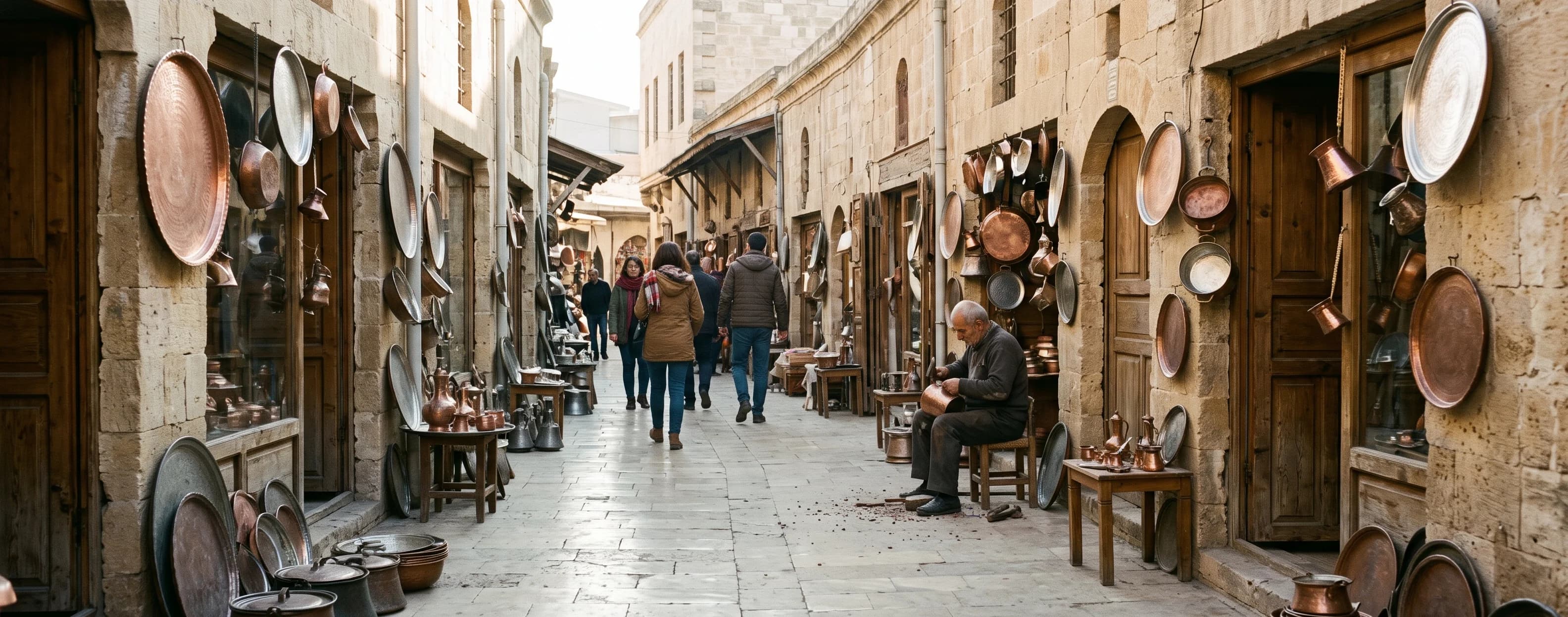
The streets below the castle are the most rewarding part of the city to explore on foot. In the Coppersmiths' Bazaar (Bakırcılar Çarşısı), artisans still hammer trays, pots, and coffee sets by hand. Nearby, the Zincirli Bedesten, a restored Ottoman covered market, and the Gümrük Hanı, an old caravan inn, now house shops and cafés. Stop at Tahmis Kahvesi, a coffee house dating to the 17th century, rebuilt after a fire in the early 1900s. It is a good place to try menengiç coffee, a caffeine-free drink made from roasted terebinth berries, a wild relative of the pistachio, usually served with milk.
Old Quarters, Churches, and Museums
West of the bazaars, narrow lanes lead through neighborhoods of honey-colored stone houses with inner courtyards. Many once belonged to Armenian families, and some have been restored as boutique hotels, cafés, and small museums. The Kurtuluş Mosque was built in 1892–93 as the Armenian Cathedral of the Holy Mother of God and became a mosque in 1986. Its dome and minarets fell in the 2023 earthquakes, so ask locally whether the building is open again.
The Gaziantep Archaeology Museum reopened in August 2026 after post-earthquake restoration. It complements the mosaic museum with finds from across the region. Together with the Panorama Museum and the bazaars, it fills a full day in the center.
A City Built Around Food
Food is the main reason many Turks visit Gaziantep. Antep baklava, made with thin layers of pastry and local pistachios, became the first Turkish product registered with protected geographical status in the European Union in 2013. Locals often eat it in the morning, or they start the day with katmer, a crisp, thin pastry filled with pistachio and clotted cream. Another early meal is beyran, a spicy lamb-and-rice soup served from dawn in small restaurants around the old city.
Lunch and dinner bring kebabs grilled over charcoal, ali nazik (meat served on smoky eggplant purée with yogurt), and yuvalama, a soup with tiny rice-and-meat dumplings. Pistachios appear in almost everything, from sweets to sausages. In late summer and autumn, you may see families shelling the new harvest outside their homes. A food walk through the bazaars is one of the easiest ways to understand the city.
Day Trips: Rumkale, Halfeti, Zeugma, and Yesemek
The Euphrates flows east of the city, and several of the region's most scenic places lie along it. Rumkale is a ruined fortress on a high bluff above the river, still within Gaziantep Province. During the 12th and 13th centuries, the Armenian Catholicos, head of the Armenian Church, resided here until the Mamluks took the fortress in 1292. Most visitors see it from the water on a boat trip from Halfeti. Check in advance whether landing at the site is currently allowed.
Halfeti lies across the provincial border in Şanlıurfa Province, about 100 kilometers from Gaziantep. When the Birecik Dam reservoir filled around 2000, much of the old town was submerged, and today a mosque minaret still rises from the water. Boats leave from the waterfront, and the town is also known for its rare black roses. The Zeugma excavation site, near Nizip, shows the parts of the ancient city that remain above the water.
Southwest of the city, near Islahiye, is the Yesemek Open-Air Museum. In Hittite times, sculptors carved lions, sphinxes, and mountain gods from basalt here. Around 300 finished and half-carved pieces still lie on the hillside. It is about 113 kilometers from Gaziantep, so plan at least a half-day trip.
Getting There and Around
Gaziantep Airport, outside the city, has frequent domestic flights, especially to Istanbul. Long-distance buses connect the city with most of Turkey. Within Gaziantep, a tram network and the Gaziray commuter rail line serve parts of the city. However, most sights in the old center are best reached on foot. A car, a driver, or an organized tour makes it far easier to reach Rumkale, Halfeti, and Yesemek, because public transport to these places is limited.
Many travelers combine Gaziantep with Şanlıurfa and Göbeklitepe to the east, or with the Commagene sites around Mount Nemrut in Adıyaman. To the southwest, Antakya and its mosaic collection make another natural pairing, and Adana is a short drive west.
When to Visit
The climate swings between dry, scorching summers and cool, rainy winters. The best weather for walking and day trips comes in spring and autumn, roughly mid-April through early June, and again in September, October, and November. July and August are often very hot in the afternoon, so plan museum visits for midday. Winters are mild compared with eastern Turkey, though frost and occasional snow are possible.
The pistachio harvest runs from late summer into autumn, and the city is especially lively then. Whatever the season, give yourself at least two full days: one for the mosaic museum and the bazaars, and one for food and a trip to the Euphrates.