
Amasya
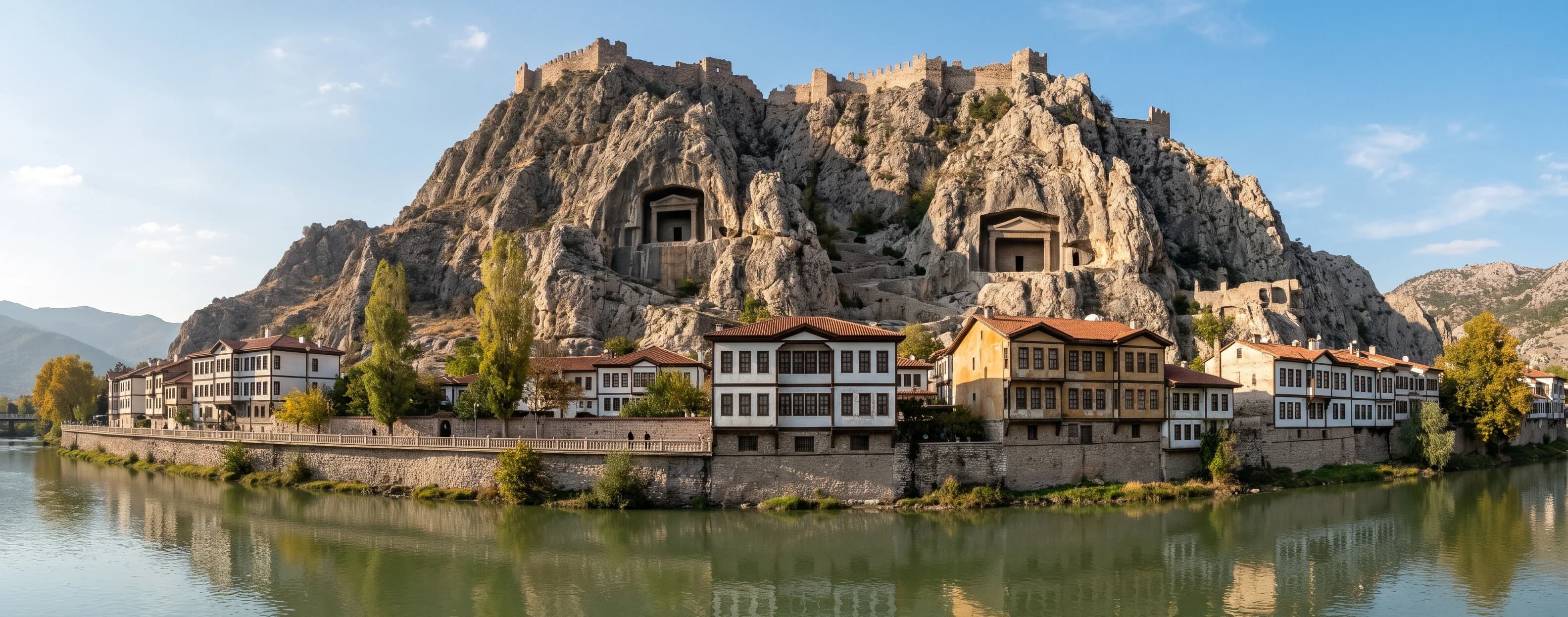
Amasya is a small riverside city in north-central Turkey, set in a narrow gorge of the Yeşilırmak River between the Black Sea coast and the Anatolian plateau. Above the water, the rock-cut tombs of the Pontic kings look out from the cliffs of Mount Harşena, and castle walls run along the ridge above them. Below, a row of Ottoman houses lines the riverbank. Amasya was the first capital of the Kingdom of Pontus, the birthplace of the geographer Strabo, and later a training ground for Ottoman princes. The compact old town can be covered on foot in a day or two, and the city makes a good base for visiting the Hittite capital of Hattusa.
Let the activities begin!
No tours match these filters yet. Try another destination or browse all tours.
The Rock Tombs of the Pontic Kings
Amasya's signature sight is the line of royal tombs carved into the limestone cliff on the north bank of the river. In the Hellenistic period, Amaseia, as the city was then known, served as the first capital of the Kingdom of Pontus, and its early kings were buried here in chambers cut straight into the rock face. The largest tomb is about 15 meters high. When the Pontic kings moved their capital to Sinope on the Black Sea coast, the custom of burying rulers in the Amasya cliffs ended.
Steps climb from the old town to the terraces in front of the tombs. Here you can see the carving up close and look back across the river to the domes and minarets of the south bank. In 2015, Turkey added Mount Harşena and the Pontic royal tombs to its UNESCO tentative list, a required stage before any World Heritage nomination.
Harşena Castle and the View Over the Gorge
Above the tombs, the walls of Harşena Castle follow the ridge of Mount Harşena, roughly 300 meters above the city center. The fortress was attacked and rebuilt many times over the centuries. The Seljuk sultan Mesud I repaired its inner castle in the 12th century. Inside the walls are cisterns, the remains of an Ottoman bathhouse, and more rock tombs. Most visitors come for the view. The whole city lies below, with the river curving through the gorge. The climb is steep and has little shade, so tackle it in the cool of the morning or toward sunset and carry water.
A City of Princes
Ottoman sultans often sent their sons to govern Amasya to prepare them for the throne. Twelve princes served here, and seven later became sultans. This is why Amasya is still called the "City of Princes." The legacy shows in its buildings. The Sultan Bayezid II Mosque, completed in 1486, is the centerpiece of the city's largest külliye (mosque complex), with a madrasa, a public kitchen, and a library.
Older still are the 13th-century Seljuk Gök Medrese Mosque and the Darüşşifa, a hospital built in 1308 under the Ilkhanids. According to the provincial culture directorate, patients there were treated with music and the sound of running water. Sabuncuoğlu Şerefeddin, regarded as one of the great Ottoman surgeons, trained at this hospital, and the building now houses a medical history museum named after him.
The Riverside Old Town and Its Museums
Along the north bank of the Yeşilırmak, the Yalıboyu houses sit atop the old city walls, their bay windows hanging over the water. Hazeranlar Mansion, built in 1865 by Hasan Talat Efendi and named after his sister Hazeran Hanım, has been restored as a museum house. Its ethnographic collection includes carpets, kilims, kitchenware, embroidered caftans, and silver jewelry.
On the south bank, the Amasya Museum covers the region's history from the Chalcolithic period to the Ottoman era. Highlights include a Hittite figurine of a storm god and a Roman-era mosaic depicting an apple tree with partridges, found near the village of Yavru in 2013. In the museum garden, Sultan Mesud's tomb holds mummified remains from the Ilkhanid period, the museum's best-known exhibit. Hours and admission fees are revised from time to time, so confirm them on muze.gov.tr, the state museum portal, shortly before your visit.
Day Trips and Nature Near Amasya
Amasya is a practical base for one of Anatolia's most important archaeological sites. Hattusa, the Hittite capital near Boğazkale in Çorum Province, is about 85 kilometers away, a roughly 90-minute drive. In the Taşova district, 63 kilometers from the city, Borabay Lake lies at about 1,050 meters, surrounded by beech, pine, cedar, and chestnut forest with walking trails and picnic areas. Amasya also fits into a longer route across central Anatolia that links Ankara, Hattusa, and Cappadocia.
Getting to Amasya
The nearest airport is Merzifon-Amasya Airport, about 41 kilometers northwest of the city, with domestic flights to Istanbul. Samsun, about 130 kilometers north on the Black Sea coast, has a larger airport and more connections. Intercity buses reach Amasya from Ankara in about five to six hours and from Istanbul in about 10 hours. A slow regional train also links Amasya with Samsun once a day. The old town is compact, and most sights on both banks are within walking distance, connected by several bridges.
When to Visit and What to Eat
For walking, the gentlest weather usually runs from mid-April into early June, then returns in September and October. In July and August, the valley heat can be intense, and winter brings cool, damp weather. From September, the harvest of Amasya's misket apples begins; this local variety has a geographical indication, and you will see it in markets across the city. Local specialties include keşkek, a slow-cooked dish of wheat and meat, bakla dolması, and the city's own çörek pastries.