7 Churches in Asia Minor (06 Night – 07 Days Turkey)
The Seven Churches of Revelations or the Churches of Apocalypse that are in the book of John refer to seven major cities through Western Turkey.
Check availability
IstanbulPrivate Tour

Bursa is a large city in northwestern Turkey, along the foot of Mount Uludağ just south of the Sea of Marmara. The Ottomans made it their first capital, and UNESCO lists its early mosques, tombs, and covered markets along with the nearby village of Cumalıkızık. Travelers come for the Grand Mosque and the Green Mosque, the silk shops of Koza Han, and İskender kebab, first served in Bursa. Beyond the city, a long gondola lift climbs to the ski slopes of Uludağ, and day trips reach İznik, the ancient Nicaea, and the lake village of Gölyazı. Fast ferries link the Bursa coast with Istanbul in about two hours.
The Seven Churches of Revelations or the Churches of Apocalypse that are in the book of John refer to seven major cities through Western Turkey.
Check availability
Bursa was the Byzantine town of Prusa until 1326, when Ottoman forces under Orhan Gazi took it and made it their capital. The court later moved to Edirne and then Istanbul, but the first six Ottoman sultans are buried in Bursa, and the mosques, schools, and baths they founded still stand there. In 2014, UNESCO listed eight parts of it, together with Cumalıkızık, as the World Heritage Site "Bursa and Cumalıkızık: the Birth of the Ottoman Empire." Most of these parts are külliyes, complexes built around a mosque with a school, a bathhouse, a public kitchen, and the founder's tomb, all supported by charitable foundations.
At the center of old Bursa stands the Grand Mosque (Ulu Cami), built around 1400 for Sultan Bayezid I. Its twenty domes rest on twelve massive pillars, and a marble fountain for ablutions stands inside the prayer hall. Large calligraphy panels, added by different masters over the centuries, cover the walls and pillars.
Beside the mosque lies the old commercial quarter, also part of the UNESCO site. Koza Han, the silk caravanserai built in the late 15th century, has a small mosque raised in the middle of its courtyard, and its shops sell silk scarves and fabrics. Nearby, Emir Han, the covered Bedesten, and the lanes of the Grand Bazaar (Kapalıçarşı) still trade in towels, knives, and local sweets.
Bursa is also the home of Karagöz shadow theater. According to legend, Karagöz and Hacivat worked on Orhan Gazi's mosque, and their jokes slowed the other builders down. Their comic dialogues became Turkey's traditional shadow play, which UNESCO added to its intangible cultural heritage list in 2009. The city has a Karagöz Museum, and the two characters appear on souvenirs throughout the bazaars.
East of the center, the Green Mosque (Yeşil Cami) and the Green Tomb (Yeşil Türbe) were built for Sultan Mehmed I in the early 15th century. Both are known for their tilework. Turquoise tiles cover the tomb, and the mosque's interior has some of the richest early Ottoman decoration in the city. The complex's former school now houses the Museum of Turkish and Islamic Arts.
On Tophane hill, a short walk from the bazaars, stand the tombs of Osman Gazi, the dynasty's founder, and his son Orhan, next to an Ottoman clock tower with wide views over the city. West of the center, the Muradiye Complex of Sultan Murad II is quieter, with a peaceful garden around the tombs of princes and other royal family members. The complexes of Orhan, Murad I, and Bayezid I are spread across other districts, and visiting several in one day shows how the early Ottomans planned Bursa around these foundations.
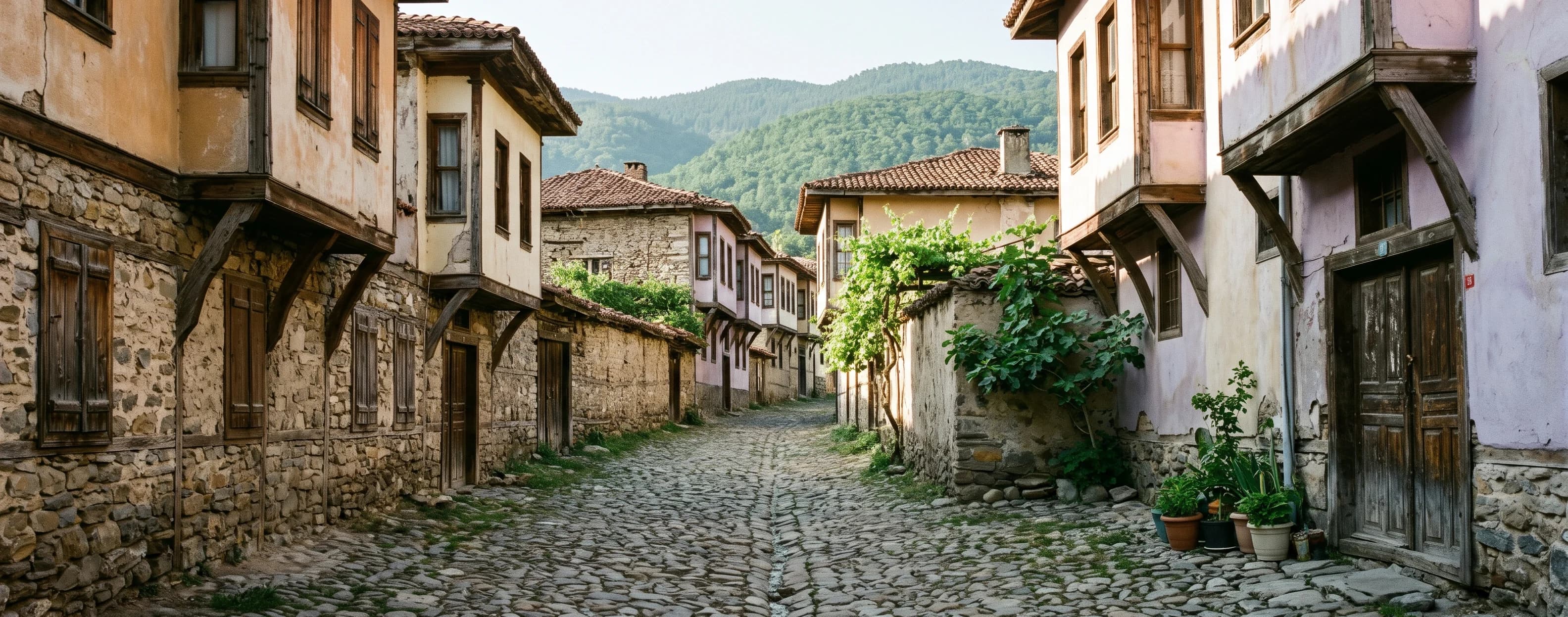
Cumalıkızık, on the lower slopes of Uludağ east of the city, is the only village in the UNESCO listing. It dates from the early Ottoman period, when rural settlements supported the city's foundations. Its narrow cobbled lanes are lined with two- and three-story houses of timber, stone, and adobe. Most visitors come for a long village breakfast in a courtyard, a walk through the lanes, and stalls selling homemade jams and local produce. It gets crowded on weekends, so weekday mornings are the calmest time to visit.
Uludağ, the ancient Mysian Olympus, rises to 2,543 meters directly behind Bursa and draws visitors year-round. An 8.8-kilometer gondola lift climbs from Teferrüç station in the city to the hotel area at about 1,870 meters, stopping at Kadıyayla and Sarıalan along the way. The full ride takes around 22 minutes and offers wide views over Bursa and the plain below.
In winter, Uludağ is among Turkey's most popular ski areas, with hotels, lifts, and slopes grouped near the top of the mountain road. The season depends on snowfall and usually runs from December into March. In summer, the meadows at Sarıalan are popular for picnics and short walks, and the national park's forests stay cool when the city below is hot.
Bursa's hot springs have drawn bathers since Roman and Byzantine times. The Çekirge district, on the slopes west of the center, is lined with thermal hotels, and several historic Ottoman bathhouses are still in use. Eski Kaplıca, built on older foundations, and Yeni Kaplıca, rebuilt in the 16th century, are two of the best known. Traditional baths have separate sections or hours for men and women, so check the arrangements at the door.
About 80 kilometers northeast of Bursa, the lakeside town of İznik is the ancient Nicaea. In 325, bishops gathered here for the first ecumenical council of Christianity, which produced the first version of the Nicene Creed; a later council in 787 met in the town's Hagia Sophia, now a mosque. The council's 1,700th anniversary drew new attention in 2025. On November 28 that year, Pope Leo XIV and Ecumenical Patriarch Bartholomew prayed together among the excavated walls of the Basilica of St. Neophytos on the shore of Lake İznik.
Roman and Byzantine walls still surround much of the town, with monumental gates such as the Istanbul Gate. From the 15th to the 17th centuries, İznik's workshops made the cobalt, turquoise, and red-glazed tiles and ceramics that decorated Ottoman mosques and palaces, and local workshops keep the craft alive today. With a lakeside lunch, the town fills a relaxed day trip.
Gölyazı sits on a small peninsula in Lake Uluabat, about an hour west of central Bursa, on the site of ancient Apollonia ad Rhyndacum. Local boatmen take visitors around the shoreline and reed beds. In spring, storks nest in nearby villages, and Gölyazı itself is known for its sunsets and lakeside breakfasts. Its old Church of St. Panteleimon now serves as a cultural center.
On the Marmara coast north of the city, Mudanya is a port town with a seafront promenade and the house where the Mudanya Armistice was signed in 1922, now a museum. A short drive west, Trilye (Zeytinbağı) is a hillside village of old stone houses above a small harbor, popular for seafood lunches.
Bursa is one of Turkey's best cities for food. İskender kebab was first served here in the 19th century: thin slices of lamb from a vertical spit laid over cubes of pide, covered with tomato sauce, doused in hot melted butter, and served with a spoonful of yogurt. The family restaurant claims its invention dates to 1867. Other local favorites include pideli köfte, meatballs on bread with butter and yogurt; cantık, a small pide topped with minced meat; and candied chestnuts (kestane şekeri), sold in gift boxes all over the center. In summer, look out for Bursa peaches from the surrounding plain.
Most visitors reach Bursa from Istanbul. İDO and BUDO run fast passenger ferries from several Istanbul piers to Güzelyalı and Mudanya on the Bursa coast in about two hours, with buses linking the piers to the city. Intercity buses and cars take the motorway that crosses the Gulf of İzmit. Within Bursa, a metro line and tram lines serve the main districts, but a car or driver makes it easier to reach Uludağ, İznik, and Gölyazı.
Two days cover the old city, the gondola ride, and Cumalıkızık. Add a third day for İznik or Gölyazı. Bursa also fits well on a route from Istanbul to the Aegean, heading west to Çanakkale and the Dardanelles or south toward Izmir. For a longer trip through northwestern Turkey, combine it with Istanbul or the lakes and forests of Bolu.