
Diyarbakır
Diyarbakır is one of the largest cities in southeastern Turkey, built on a basalt plateau above the Tigris River. Its old town, known as Sur, is still enclosed by dark stone walls that UNESCO listed in 2015 together with the Hevsel Gardens, which slope down to the river. Inside the walls are the Great Mosque, Ottoman caravanserais, centuries-old churches, and lanes of black basalt houses. The city also serves as a practical base for Zerzevan Castle, a Roman frontier fort with a rock-cut temple, and for trips south to Mardin. It suits travelers who enjoy history, architecture, and Upper Mesopotamian food.
Let the activities begin!
No tours match these filters yet. Try another destination or browse all tours.
The City Walls and İçkale
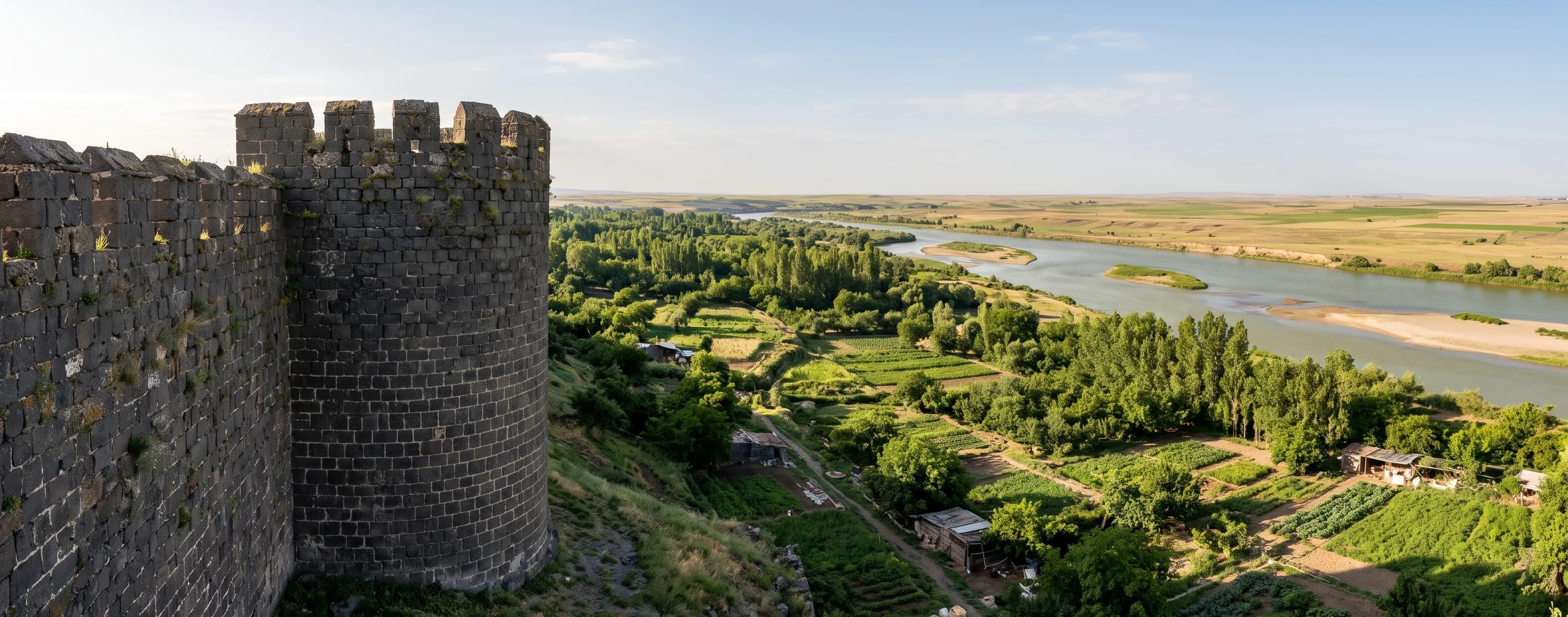
Diyarbakır's walls run about 5.8 kilometers around the old town, and much of the ring still stands. The masonry is mostly dark basalt, giving the walls their nearly black color. The present walls date back to the Roman period in the 4th century AD, when the city was called Amida. Later rulers repaired and extended them many times. Around 63 inscriptions from the Byzantine and Islamic periods record that history, and many towers carry carved animals, bands of script, and decorative stonework.
Four main gates lead into the old town: Dağkapı (also called the Harput Gate) in the north, Urfa Gate in the west, Mardin Gate in the south, and Yenikapı in the east. Among the finest towers are Ulu Beden and the Yedi Kardeş (Seven Brothers) Tower, both built by the Artuqid dynasty in the early 13th century. The lion reliefs on Yedi Kardeş are best seen from outside the walls. In the northeast corner, the citadel of İçkale stands on the ancient mound of Amida, and its ramparts overlook the Tigris valley. You can walk several sections of the walls, but some stretches are uneven and quiet. Go with a companion and keep your camera and phone secure.
Hevsel Gardens and the Ten-Eyed Bridge
Between the old town and the Tigris, the Hevsel Gardens cover around 700 hectares of terraced land. Fed by springs, these plots supplied Diyarbakır with fruit, vegetables, and water for centuries. Local families still farm them today. Mulberry, fig, and apricot trees shade the vegetable beds, and the riverbank attracts many birds. The gardens are part of the World Heritage Site, and the views from the walls above are among the best in the city.
About 3 kilometers south of the old town, beyond the Mardin Gate, the Ten-Eyed Bridge (On Gözlü Köprü) crosses the Tigris on ten stone arches. An inscription dates it to 1065, during the Marwanid dynasty. The bridge stretches about 178 meters. Motor traffic moved to a newer bridge nearby in 2009, so the old crossing is now a place to stop for photos and river views, especially in the late afternoon.
The Great Mosque and the Heart of Sur
The Great Mosque (Ulu Camii) stands at the center of the old town and ranks among Anatolia's oldest mosques. Its earliest inscription dates to 1091–92, under the Seljuk sultan Malik-Shah. The courtyard is paved with basalt, and its two-story facades reuse columns and carved stonework from earlier Byzantine buildings, a striking mix of styles. The Mesudiye Madrasa, an Artuqid school built around the turn of the 13th century, adjoins the mosque. The mosque is still used for daily prayers, so visit outside prayer times.
Across the street, Hasan Paşa Hanı is a 16th-century caravanserai built between 1573 and 1575. Its arcaded courtyard now holds breakfast cafés and small shops, and it is a favorite meeting point for locals. Nearby, the minaret of the Şeyh Mutahhar Mosque, known as the Four-Legged Minaret (Dört Ayaklı Minare), rests on four slender stone columns and is one of the city's most photographed landmarks. Walk on to the Behram Paşa and Safa mosques, the house where poet Cahit Sıtkı Tarancı was born, and the Dengbêj House, where performers keep alive the Kurdish tradition of storytelling in song.
Churches and a City of Many Communities
For centuries, Diyarbakır was home to Kurdish, Turkish, Armenian, Syriac, Arab, and other communities, and its churches reflect that past. The Meryem Ana (Virgin Mary) Church, whose origins are traced to the 6th century, still serves the city's Syriac Orthodox congregation. St. Giragos, one of the region's largest Armenian churches, was restored and reopened in 2011, closed after the 2015–16 clashes, and reopened after renovation in 2022. Church opening arrangements can change, so confirm locally before you go, and dress respectfully when visiting.
Zerzevan Castle and Day Trips
About 45 kilometers southeast of the city, on the road toward Mardin, Zerzevan Castle crowns a hilltop in the Çınar district. It was an Eastern Roman military settlement built in the 4th century to guard the route between Amida and Dara. Excavations since 2014 have revealed walls, a church, houses, and an underground Mithraic temple carved into the rock, one of the best-preserved structures at the site. Zerzevan is on UNESCO's Tentative List, and parts of the site are open to visitors.
Many travelers combine Zerzevan with Mardin, whose old town of stone houses spills down a hillside above the Mesopotamian plain. Closer to Diyarbakır, the Artuqid-era Malabadi Bridge spans the Batman River to the east, while Eğil, north of the city, sits beside a dam lake. For travelers covering more of the region, Şanlıurfa and Adıyaman, the gateway to Mount Nemrut, are both reachable by road.
Food in Diyarbakır
Breakfast is a highlight here. Cafés in Hasan Paşa Hanı and around the old town serve long spreads of cheeses, olives, honey, eggs, fresh bread, and tea. Later in the day, look for grilled liver (ciğer) cooked over charcoal, meat dishes served with rice or bulgur, and syrup-soaked kadayıf with walnuts or pistachios. In summer, the city is known for its large watermelons, which it celebrates with a festival traditionally held in September.
Getting There and Getting Around
Diyarbakır Airport has domestic flights, including connections from Istanbul, and long-distance buses link the city with other parts of the country. The walled old town is small enough to cover on foot, though the bridge, the riverside gardens, and the newer districts are easier to reach by taxi. For Zerzevan, Malabadi, and Mardin, travel by rental car, hire a private driver, or join a guided tour.
When to Visit and How Long to Stay
Spring, from April to early June, is the best time to come, when the Hevsel Gardens are green and the days are warm. September to early November is also pleasant. Summers are long, hot, and dry, so plan outdoor walks for early morning and evening. Winters are cool to cold, with occasional frost. Allow two days for the walls, the old town, and the gardens, and a third day for a trip to Zerzevan and Mardin.