From Pirate Harbor to Fishing Village
Greek settlers from Cyme in Aeolis most likely founded Side in the 7th century BC on a rocky, easy-to-defend cape. The name is usually translated as "pomegranate" in an ancient Anatolian language, and Athena, the city's patron goddess, appears on many of its coins. Alexander the Great took the city without a fight in 333 BC. In the 1st century BC, Side became a base for Cilician pirates and a busy slave market until Roman campaigns ended the pirates' power in 67 BC.
Under Roman rule, Side grew wealthy on trade, and its population is thought to have reached about 60,000. Most surviving ruins date to this era. The city declined from the 4th century, suffered Arab raids in the 7th century, and was largely empty by the 10th. Locals later called the ruins "Old Antalya." In 1895, Muslim families from Crete settled among the stones and founded the village of Selimiye, which became today's resort town.
Walking Through the Ancient City
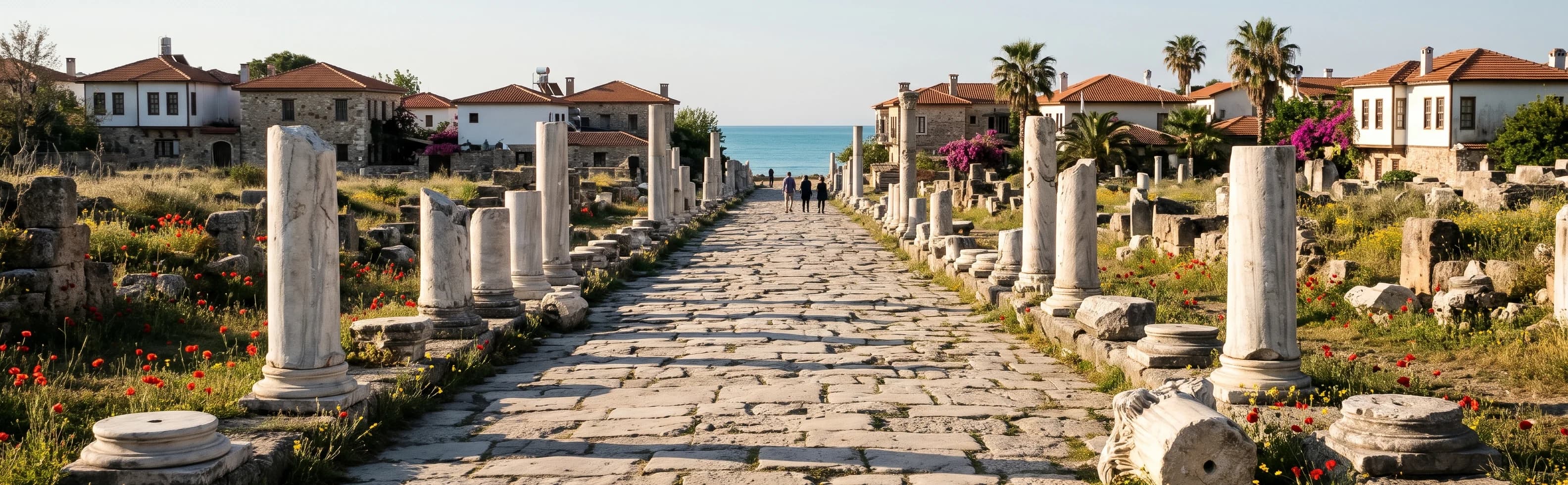
The road into Side passes through the old city walls beside a monumental gate and fountain known as the Vespasian Monument. From there, a colonnaded street leads toward the peninsula. Along the way, you pass the commercial agora, where the round Temple of Tyche once stood in the square. Opposite the agora, a Roman bath building now houses the Side Museum, with statues, sarcophagi, and reliefs from the city and its surroundings.
The theater is the largest single monument in Side. Dating from the 2nd century AD, it seated more than 15,000 spectators and hosted plays, ceremonies, and gladiator fights. Restoration work continues, so parts of the seating can be fenced off. Beyond the theater, the remains of the State Agora, a Byzantine basilica, and the city's harbor baths lie scattered among the fields and lanes. Water reached Side through a Roman aqueduct about 30 kilometers long, built in the 2nd century AD, and sections of it survive inland toward the Manavgat River.
The Temples of Apollo and Athena
At the end of the peninsula, the Temple of Apollo's re-erected marble columns rise from the rocks beside the sea. Beside them are the remains of a temple dedicated to Athena. The setting faces west across the bay, so the late afternoon and sunset draw the biggest crowds. Early morning is quieter and better for photographs. A path follows the shoreline from the temples past the ancient harbor, where traces of the old breakwater lie under the water.
Beaches and the Modern Town
Most traffic stops at the edge of the old town. Visitors leave their cars outside the walls and walk in or take a small shuttle from the theater area. Inside, souvenir shops, bars, and restaurants fill the lanes between the ruins, and fishing boats and excursion boats tie up along the harbor. The streets are busiest in the evening, when the day's heat breaks.
Long sandy beaches run along the coast on both sides of the peninsula, backed by hotels that stretch for several kilometers, including toward the coastal village of Kumköy. The sand shelves gently into the sea, which makes these beaches popular with families. Most hotels and public beaches offer sunbeds and umbrellas for rent in season.
Day Trips from Side
Side sits in the Manavgat district, and the town of Manavgat lies just inland. Boats run up the Manavgat River toward the Manavgat Waterfall, a low, wide cascade about 3 kilometers north of the town center, and many trips include time at a market in Manavgat. Farther inland, the Green Canyon area near the Oymapınar Dam is known for boat trips between steep, forested slopes, and Köprülü Canyon is a popular rafting destination.
The Roman theater at Aspendos, one of the best-preserved ancient theaters anywhere, lies about 37 kilometers west of Side and pairs easily with Perge on a day of sightseeing. Farther along the coast, Alanya offers a hilltop castle, sea caves, and a lively harbor roughly an hour's drive east.
Getting to Side
Antalya Airport is the nearest airport, roughly an hour west by car, and Antalya city is around 75 to 80 kilometers away along the coastal highway. Intercity buses stop at Manavgat's bus station, and minibuses and taxis cover the short trip to Side. A car makes day trips easier, but there is little point in driving inside Side itself, as everything in the old town lies within walking distance.
Planning Your Days
The ancient city, the museum, and the temples fit comfortably into a single unhurried day. Many visitors stay for a week or more as a beach holiday and use Side as a base for excursions. Three or four days let you combine the ruins, a boat trip on the Manavgat River, and a visit to Aspendos without rushing.

 SOLD OUT