
Zeugma
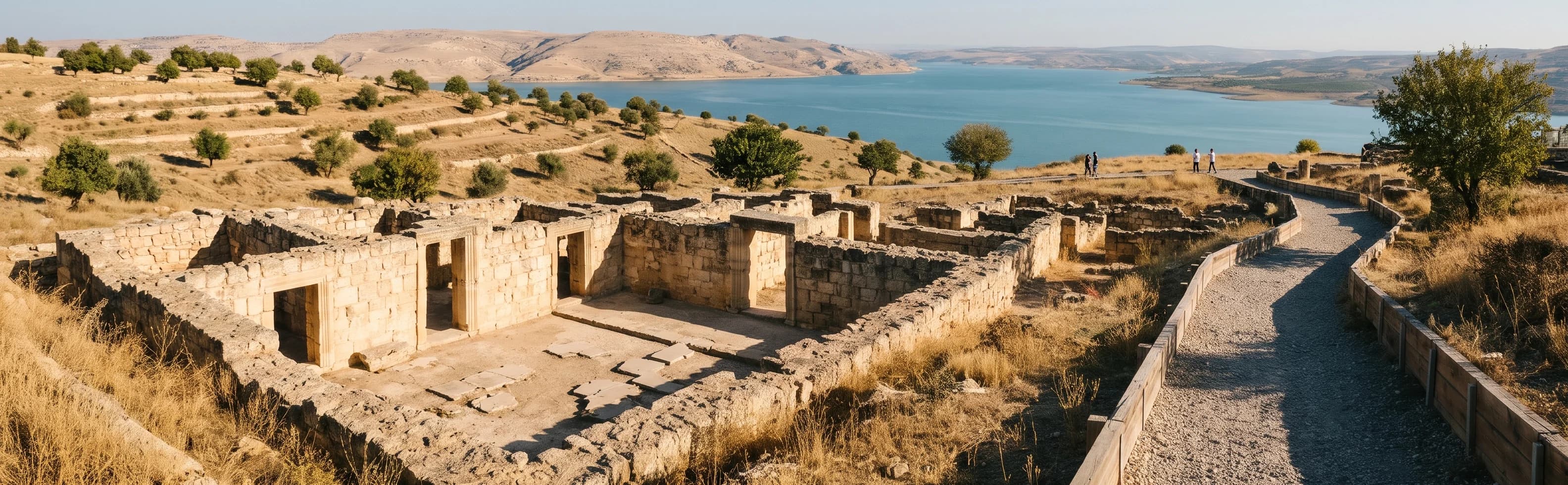
Zeugma is an ancient city on the Euphrates River in southeastern Turkey, near the village of Belkıs in Nizip district, about 50 kilometers east of Gaziantep. Seleucus I, one of Alexander the Great's generals, established it around 300 BC. It later grew into a wealthy Roman frontier town at a key river crossing. Today, its fame rests on its mosaics. Before the waters of the Birecik Dam covered its lower slopes around 2000, archaeologists worked quickly to rescue villas with exceptional floor mosaics, which now fill Gaziantep's Zeugma Mosaic Museum. At the site, you can walk among excavated houses under a protective roof and look out over the river. Read on for the history, the sights, and how to plan a visit.
Let the activities begin!
No tours match these filters yet. Try another destination or browse all tours.
A City Named for a Crossing
Seleucus I Nicator founded the city around 300 BC on the west bank of the Euphrates and named it Seleucia after himself. A twin settlement on the opposite bank, Apamea, took the name of his Persian wife, Apama. A bridge linked the two. When the city passed into the Roman world in the first century BC, it became known as Zeugma, a Greek word for a bridge or crossing.
For a time, it was one of the main cities of the kingdom of Commagene, whose kings left giant stone statues on the summit of Mount Nemrut in what is now Adıyaman province. Under Rome, Zeugma became an important frontier post, and a Roman legion was based here in the first century AD. Trade through the river crossing made it rich. At its height, tens of thousands of people lived there. Its prosperity ended in the mid-third century AD when the Sasanian Persian king Shapur I sacked the city. Zeugma never fully recovered and was abandoned by the seventh century.
What You See at the Site Today
The archaeological site covers a hillside above the river. Its highlight is a group of excavated Roman houses beneath a large modern roof, completed in 2010, which protects mosaics and wall paintings left in place. From inside the shelter, you can look down into rooms and courtyards and get a sense of how wealthy families lived. Many of these villas were large homes built around courtyards, decorated with floor mosaics from the second and third centuries AD.
Beyond the shelter, much of the city remains unexcavated or lies underwater. Archaeologists have identified agoras, a theater, a stadium, baths, sanctuaries, and the camp where the Roman legion was stationed. Visitor facilities include parking, restrooms, a café, and a small shop.
The Mosaics in Gaziantep
Zeugma's greatest finds are in Gaziantep, at the Zeugma Mosaic Museum. It opened in 2011 and is one of the world's largest mosaic museums. The museum has reassembled entire villa floors, so that you can walk around mythological scenes at their original scale. Its best-known piece, nicknamed the Gypsy Girl, shows part of a woman's face with a haunting gaze. A dozen fragments of this mosaic left Turkey illegally decades ago and came back from America in 2018.
Visiting both places gives the full picture: the museum shows the art at its best, while the site shows where it came from. A good plan is to visit the museum first, then drive out to the river.
The Dam and the Rescue Excavations
Zeugma has been studied for decades. Scientific excavations began in 1987, and since 2005, Ankara University has led the digs. Things became urgent when the Birecik Dam on the Euphrates came into use around 2000. Its reservoir flooded the lower part of the ancient city, by one estimate, about a third of its area.
An emergency excavation, partly funded by the Packard Humanities Institute, raced against the rising water to save mosaics, frescoes, and other finds. Archaeologists found a bronze statue of Ares, the god of war, and more than a thousand clay seals. The story drew international attention, and in 2012, Turkey put Zeugma on its UNESCO tentative list, a step toward World Heritage nomination.
Combining Zeugma with Halfeti and Rumkale
The Euphrates valley around Zeugma offers more. Upstream, the town of Halfeti in Şanlıurfa province sits beside the same reservoir, with part of the old town now underwater, and boat trips on the river. The medieval fortress of Rumkale rises on a rocky outcrop above the water and is usually reached by boat. Check locally whether visitors can land at the fortress before you plan around it.
A day out can start at the mosaic museum in Gaziantep, continue to the site at Belkıs, and finish on the river by boat. With more time, you can continue east to Şanlıurfa and Göbekli Tepe.
Getting to Zeugma and Timing Your Visit
The site is about 10 kilometers from the district town of Nizip and about 50 kilometers east of Gaziantep. The usual approach is by road from Gaziantep, either driving yourself or hiring a driver for the day. Gaziantep's airport has domestic flights.
Allow one to two hours at the site and two to three hours at the museum. Opening hours change with the seasons, and both charge admission, so check the official Turkish museums website before you go.