
Aspendos
Aspendos is an ancient city in Antalya province on Turkey's Mediterranean coast, beside the Köprüçay River (the ancient Eurymedon) near the village of Belkıs. It is best known for its Roman theater, one of the best-preserved theaters of the ancient world, whose stage building still stands to its full height. Beyond the theater, you can climb to the hilltop agora and basilica, see the arches of a Roman aqueduct across the plain, and look out over a medieval bridge on the river. The site is less than an hour's drive east of Antalya, so it fits easily into a day of sightseeing. This guide covers its history, what to see, and practical tips for your visit.
Let the activities begin!
No tours match these filters yet. Try another destination or browse all tours.
A Short History of Aspendos
According to ancient tradition, Greek settlers from Argos founded Aspendos. By the fifth century BC, it ranked among the most important cities in Pamphylia, the coastal plain east of modern Antalya. Even under Persian rule, Aspendos still issued its own coinage. Around 465 BC, the Athenian general Cimon defeated a Persian fleet on the Eurymedon. In 333 BC, Alexander the Great forced the city to accept a garrison and pay a heavy tribute.
Aspendos came under Roman control in the second century BC. Its great building period was under the Roman Empire, which gave the city its theater and aqueduct. In the thirteenth century, the Seljuk Turks repaired the theater and used its stage building as a palace, which helps explain why it survived so well.
The Roman Theater
The theater dates to the second century AD, the era of the Antonine emperors, and inscriptions name its architect as Zenon, a native of Aspendos. Part of the seating rests on the hillside, and the rest stands on vaulted substructures. The cavea spans about 96 meters. Estimates of how many people it held vary widely, but its size becomes clear once you stand in the top row.
The real prize here is the stage building. In most ancient theaters, it has collapsed, but here it still rises to its full height, giving a rare sense of how a Roman theater enclosed its audience. Look high on the walls for the holes that once held masts for an awning to shade the spectators. In 2015, Turkey placed the theater and aqueducts of Aspendos on its UNESCO Tentative List, the step before a World Heritage nomination.
Opera and Ballet Under the Stars
Aspendos is still a working stage. The Turkish State Opera and Ballet launched an opera and ballet festival here in 1994, and it became an international festival in 1998. Recent editions have taken place in September. The 2026 festival ran from September 12 to 26 and opened with Verdi's Attila. If you are traveling in late summer, check the program, because an evening performance is a memorable way to see the theater in use.
The Upper City: Agora, Basilica, and Nymphaeum
From the theater, a path leads up to the acropolis, the low hill that held the civic heart of Aspendos. Here, you can trace the agora, a market hall, a large basilica, and the tall front wall of the nymphaeum, the city's grand public fountain. The council house, or bouleuterion, stands nearby. These buildings are far less complete than the theater, and signs are limited, so the audio guide or a guide helps you make sense of the ruins. The hill also gives wide views over the surrounding plain.
The Aqueduct
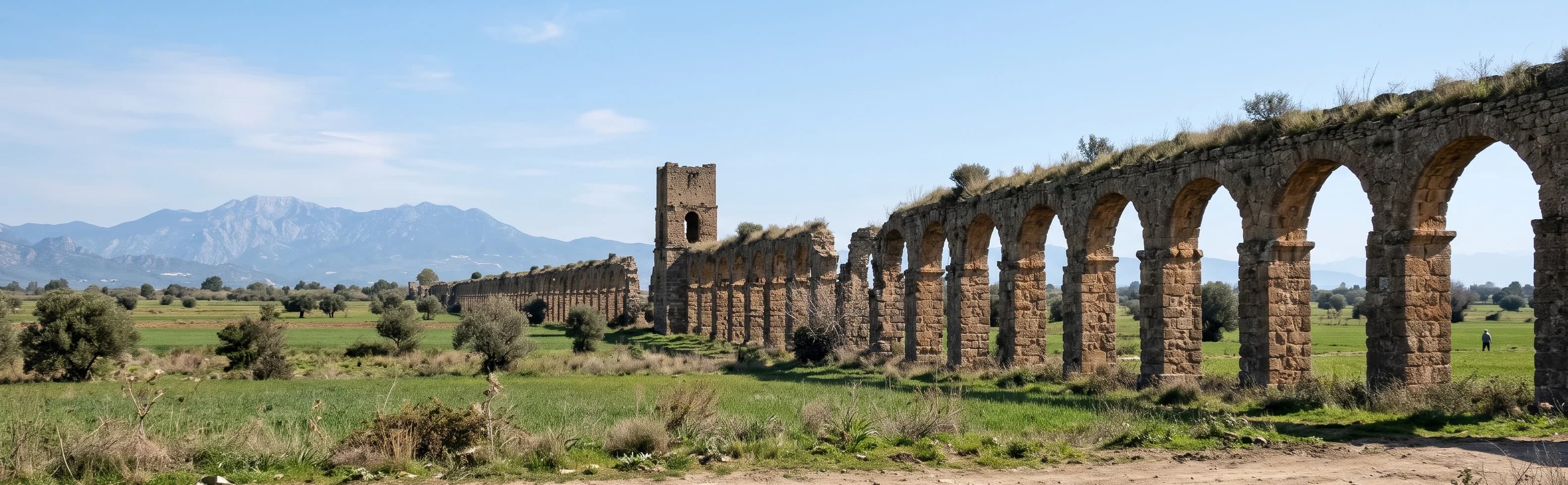
Aspendos kept much of its Roman aqueduct, a striking piece of engineering. Its channel ran for about 19 kilometers, bringing water from springs in the hills to the north. To cross the low ground in front of the city, Roman engineers built an inverted siphon: a line of arches with pressure towers about 30 meters high that pushed the water up and over toward the city. Long sections of the arches still stand in the fields north of the hill.
The Eurymedon Bridge
A few hundred meters from the approach road, a stone bridge crosses the Köprüçay. The Romans first bridged the river here, and the bridge you see today is a thirteenth-century Seljuk reconstruction. It is worth a short stop on your way in or out.
Getting There and Planning Your Time
The ruins sit just inland from the busy coastal highway that links Antalya with Side. Many visitors arrive by rental car or taxi, or on an organized excursion from Antalya or coastal resorts such as Kemer. Public transport takes longer: you would combine Antalya's tram, a Serik-bound bus, and a short taxi ride.
Two hours gives you time for the theater, the climb to the upper city, and a look at the aqueduct. Perge lies roughly 27 kilometers west and Side roughly 37 kilometers east, so either makes a natural second stop.
When to Visit
April, May, October, and early November bring mild days that suit a long walk around the site. Summers on the Antalya plain are very hot, so arrive soon after the gates open and bring plenty of water, a hat, and sunscreen. Winters are mild and quiet, though rain is more likely. The official museum website lists the ruins as open seven days a week; the gates open at 08:00, the box office closes at 16:30, and visits end at 17:00. Confirm the hours before your trip, as they may change.