
Midyat
Midyat is a stone town on the Tur Abdin plateau in southeastern Turkey, about 60 kilometers east of Mardin. Its old quarter of carved limestone mansions, church bell towers, and silversmiths' workshops is the historic center of a region where Syriac Christians have lived since late antiquity. Most visitors come for the architecture, the telkari silver filigree, and the monasteries of the surrounding countryside, including Mor Gabriel, founded in 397. This guide covers the old quarter's main sights, nearby village churches, and the best seasons to visit.
Let the activities begin!
No tours match these filters yet. Try another destination or browse all tours.
Two Towns in One
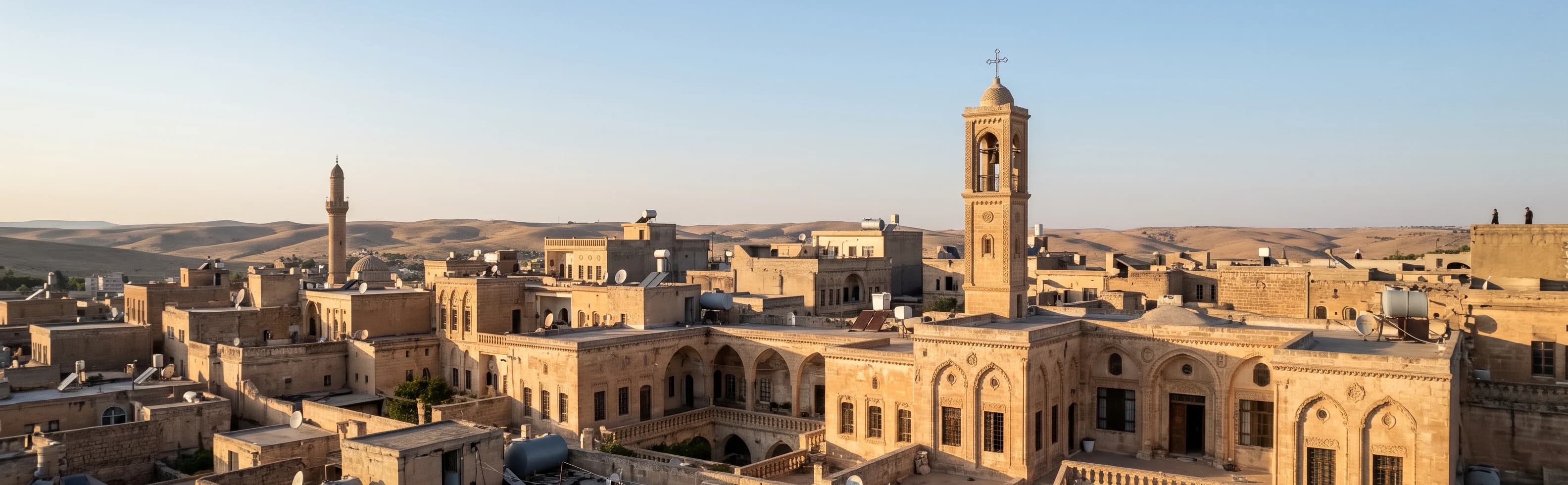
Midyat grew from two neighboring settlements. Estel, on the western side, is the newer district with the main shops, banks, and bus connections. Old Midyat lies about two kilometers east, where most travelers spend their time. Its lanes are lined with honey-colored limestone houses, many built around inner courtyards and finished with carved window frames, arched doorways, and flat roof terraces. Church bell towers and minarets rise side by side above the rooftops, as Christian and Muslim communities have shared the town for centuries.
Several restored mansions in the old quarter now operate as hotels, letting you stay inside the historic center rather than in Estel.
The Midyat Guesthouse
The best-known building in town is the Midyat Guesthouse, or Konukevi, a three-story stone mansion at the highest point of the old quarter. Its lowest room is carved directly from the bedrock, and the upper floors open onto terraces, with a roof that overlooks the whole town. The courtyard still has its old water well. Turkish television crews have used the house as a set for popular series such as Sıla and Hercai, and it is now open to visitors every day.
Syriac Churches and Monasteries
Midyat is the traditional center of Tur Abdin, a limestone plateau whose Syriac name means "mountain of God's servants." The plateau has been a heartland of Syriac Orthodox Christianity since late antiquity. The town's Christian community is much smaller than it was a few decades ago, yet several churches remain in use, and their liturgy is still sung in Syriac, a form of Aramaic. Mor Barsawmo, the most active of them, was founded as early as the fifth century, destroyed in 1793, and rebuilt in 1910.
About a kilometer east of the old town, the Mor Abrohom Monastery, also known as Mor Hobel, was founded, according to tradition, by two monks in the fifth century and was heavily restored in the early 20th century. Churches here are places of worship, and their doors are not always open. Wear modest clothing, stay quiet during services, and ask before taking photos inside.
Telkari: Midyat's Silver Filigree
Midyat is famous for telkari, a technique where fine silver wire is twisted and soldered into lace-like patterns for rings, necklaces, earrings, and brooches. The craft has a long history in the region and is still passed down from master to apprentice. In 2021, it received geographical indication status as "Midyat Telkarisi." Workshops and shops cluster in the old town's silver bazaar, where you can often watch artisans at work. In December 2023, the Midyat Telkari Museum opened in a mid-19th-century stone house built by a Syriac family, giving the craft its own home.
Mor Gabriel and the Villages of Tur Abdin
The Mor Gabriel Monastery lies about 20 kilometers from Midyat and is the highlight of most visits to the region. Founded in 397, it ranks among the world's oldest functioning monasteries and is home to the bishop who leads the Tur Abdin diocese. A small community of monks and nuns maintains daily prayers. Visitors can see a church dating from the early sixth century, along with crypts and domed chambers. Visiting hours include a midday break, so plan your arrival accordingly.
Smaller villages scattered across the plateau hold churches that are just as rewarding. Gülgöze, known in Syriac as Inwardo, has the church of Mor Hadbshabo. Anıtlı, the village of Hah, is home to the Church of Yoldath Aloho, the Mother of God, regarded as one of the region's oldest and most important churches. Mercimekli, or Habsus, northeast of Midyat, has the church of Mor Shemun. Public transportation to the villages is limited, so a rental car, a taxi hired for the day, or a guided trip is the practical way to combine several of them in one day.
Hasankeyf and Other Day Trips
Hasankeyf, about 40 kilometers north in neighboring Batman Province, is a popular half-day trip. The waters of the Ilısu Dam covered the old town in 2020, and some monuments, including the Zeynel Bey Tomb, were moved to a new site above the reservoir. To the west, Mardin's old town, the Deyrulzafaran Monastery, and the ruins of Dara are also within reach. Many travelers base themselves in Mardin and visit Midyat on a full-day trip.
Food and Wine
Midyat's cooking reflects the town's mix of communities. Look for sembusek, a half-moon flatbread filled with spiced minced meat, Syriac-style içli köfte, and kaburga dolması, lamb ribs stuffed with rice and slow-cooked until tender. To finish a meal, try mırra, an intensely bitter coffee served in small sips, or menengiç coffee made from wild pistachio. Tur Abdin is also one of Turkey's few wine-producing regions. Syriac families in and around Midyat still make wine from local grapes.
Getting There and Best Seasons
Midyat has no airport. The nearest is Mardin Airport, a little over an hour's drive away. Batman Airport is another option, about an hour and a half by road. Frequent minibuses run between Mardin and Midyat; ask the driver to let you off in the old town rather than in Estel. Diyarbakır lies roughly three hours to the northwest by road.
The weather is kindest in April, May, and early June, and again in autumn, once the September heat fades, until the end of November. Summer brings long, dry days, with afternoon highs climbing to about 35°C and sometimes passing 40°C, while winters are cold and snow is common between December and March. Turkish public holidays and summer weekends bring large crowds of domestic visitors, many of them drawn by the TV series filmed in the town.