
Sardis
Sardis was the capital of ancient Lydia, the kingdom of Croesus, and its ruins lie beside the village of Sart near Salihli in Turkey's Manisa province. Gold panned from the Pactolus stream made the Lydian kings famously rich, and the city later served as a Persian, Hellenistic, and Roman stronghold. Today, visitors walk through a restored Roman bath-gymnasium, one of the largest synagogues known from antiquity, and the massive Temple of Artemis. To the north, the royal tumuli of Bin Tepe dot the plain. UNESCO added the city and its tumuli to the World Heritage List in 2025. Read on for the key sights, the city's place in the Book of Revelation, and practical advice for your trip.
Let the activities begin!
No tours match these filters yet. Try another destination or browse all tours.
From Lydian Gold to Roman City
Sardis grew beneath a steep, eroded acropolis on the edge of the Gediz plain, where the Pactolus, today's Sart stream, carried flakes of gold from Mount Tmolus. Under the Mermnad dynasty, which held power for over a century before 546 BC, Lydia became one of the richest states in the ancient world, and the Lydians are credited with striking some of the earliest coins. Croesus, the last of these kings, lost his throne when Cyrus the Great captured the city in the mid-6th century BC.
Under Persian rule, Sardis became the seat of a satrapy and a mustering point for Persian armies under Darius and Xerxes. Alexander the Great took it in 334 BC, and it flourished again under the Seleucids and Rome. After an earthquake leveled much of the city in AD 17, Emperor Tiberius helped pay for its reconstruction. Most of the ruins visible today were built in the Roman and early Byzantine periods. Sardis declined in the Middle Ages, and the village of Sart grew among its remains.
The Bath-Gymnasium and the Marble Court
The main excavated area sits beside the Izmir–Ankara highway. At its center is a vast Roman complex combining public baths with an open exercise ground, the palaestra. On the palaestra's eastern side, the two-story Marble Court rises in tiers of columns, carved capitals, and niches. Archaeologists from the Harvard-Cornell expedition, which has worked at Sardis since 1958, pieced much of the court's facade back together from fallen blocks, giving one of the clearest pictures in Anatolia of what a grand Roman bath building looked like.
A row of small shops from the early Byzantine city lines the complex's outer wall, their doorways facing the old colonnaded street. Parts of the Lydian fortifications, up to 20 meters thick, have also been uncovered on the edge of the lower city.
The Ancient Synagogue
Excavators found the synagogue in 1962, set on the southern side of the bath-gymnasium. A Jewish community converted this long, basilica-shaped hall in late Roman times, and it remained in use for centuries. With space for close to a thousand people, it is among the largest synagogues known from the ancient world, evidence that the city's Jewish community was large and well established.
Visitors enter through a forecourt with a fountain for washing hands before prayer. Inside the main hall, you can see restored colored marble wall panels, geometric mosaic floors, and two small shrines flanking the entrance. More than eighty Greek and seven Hebrew inscriptions name donors and their families. A protective roof now shelters parts of the building and its mosaics.
The Temple of Artemis
A side road leads south from the highway up the Pactolus valley to the Temple of Artemis. Few Ionic temples anywhere were planned on such a scale. Work on its inner chamber, the cella, started in the 3rd century BC, and the Romans later divided it in two, probably so that the imperial cult could share the space with the goddess. Colossal statues of emperors and their wives once stood inside.
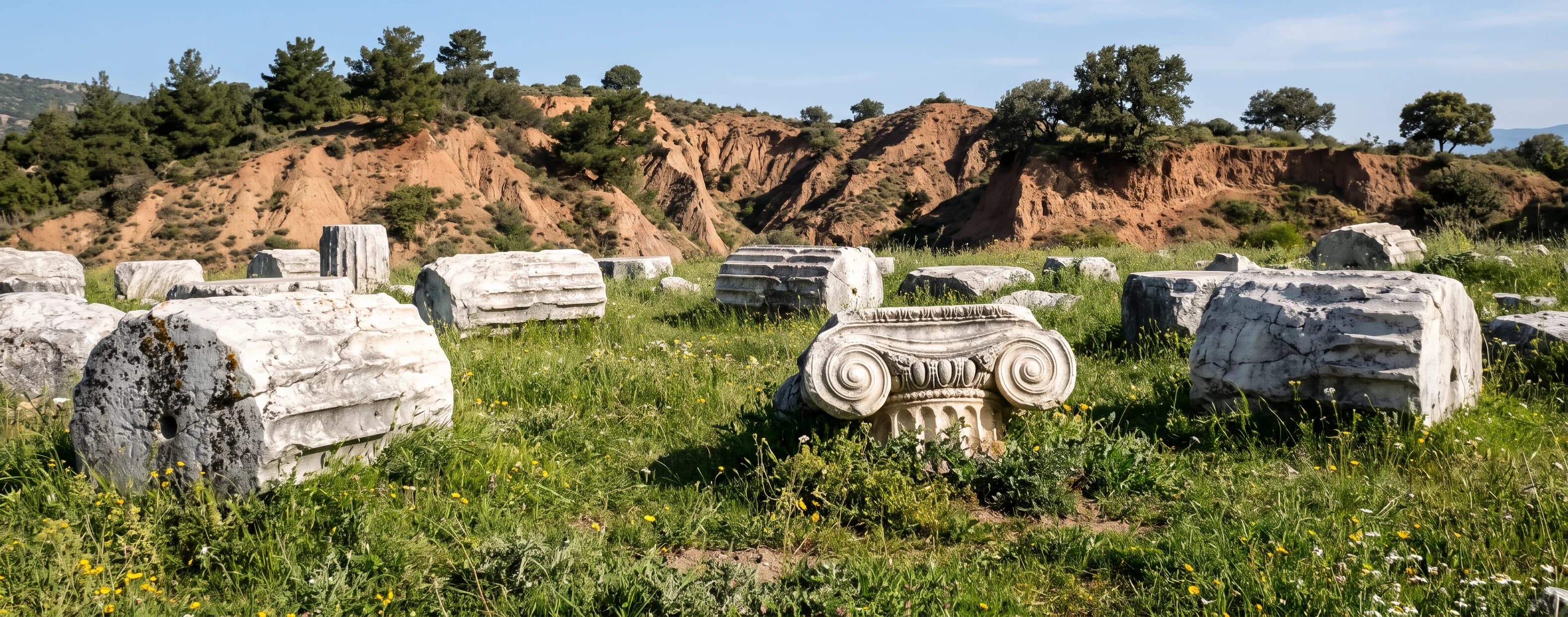
The outer colonnade was never completed, and many column drums still lie where builders left them. Two columns have stood complete since antiquity without restoration, and their size alone shows how ambitious the project was. In late Roman times, builders added a small brick church against the temple's southeast corner, one of the earliest Christian buildings found at Sardis. The acropolis rises steeply behind the temple. Its crumbling slopes and late fortifications are safer to view from below than to climb.
Bin Tepe, the Royal Tumuli of Lydia
North of the Gediz River, between the plain and the shore of Lake Marmara, more than a hundred earth mounds rise from a low limestone ridge. Their Turkish name, Bin Tepe, means "a thousand hills." These tumuli covered the tombs of Lydian kings and nobles, and the largest, traditionally identified as the tomb of King Alyattes, father of Croesus, stands more than 60 meters high. Herodotus singled it out as Lydia's greatest monument.
UNESCO's 2025 listing covers both the city and these burial grounds. The mounds are scattered across farmland and villages, so plan to tour them by car, ideally right after the city ruins.
Sardis and the Seven Churches of Revelation
The Book of Revelation includes a brief letter addressed to the Christians of Sardis. It offers them little praise and urges a complacent congregation to wake up. No church building from that first-century community has been identified. Still, the small church beside the Temple of Artemis and later churches in the city show how Christianity took root here.
Sardis fits naturally into a Seven Churches route. Thyatira (Akhisar) and Philadelphia (Alaşehir) lie in the same province, while Smyrna, Pergamon, and Ephesus are in Izmir province, and Laodicea is near Denizli. Many travelers visit Sardis on the way between Izmir and Pamukkale.
Planning Your Visit
Sardis lies about 10 kilometers west of Salihli and roughly 90 kilometers east of Izmir, about 90 minutes by car. Buses and minibuses heading from Izmir's main bus station to Salihli can drop you on the highway at Sart. The gymnasium area and the Temple of Artemis are part of the same archaeological site, but they are a short drive apart, so allow time to see both. Two or three hours covers the city ruins; give yourself half a day with Bin Tepe.
Sart has no hotels, so most visitors stay in Izmir, Manisa, or Salihli. The Manisa Archaeological Museum displays sculpture and other finds from the excavations, making it a good companion stop. East of Sardis, the lava fields and cinder cones of the Kula-Salihli UNESCO Global Geopark are close enough to combine on a longer day.