
The Seven Churches of Asia Minor (4 Nights/5 Days)
Explore Ephesus, Smyrna, Pergamum, Thyatira, Sardis, Philadelphia and Laodicea - the ancient wonders of the Seven Holy Churches of Asia as mentioned in the Book of Revelation.
Check availability

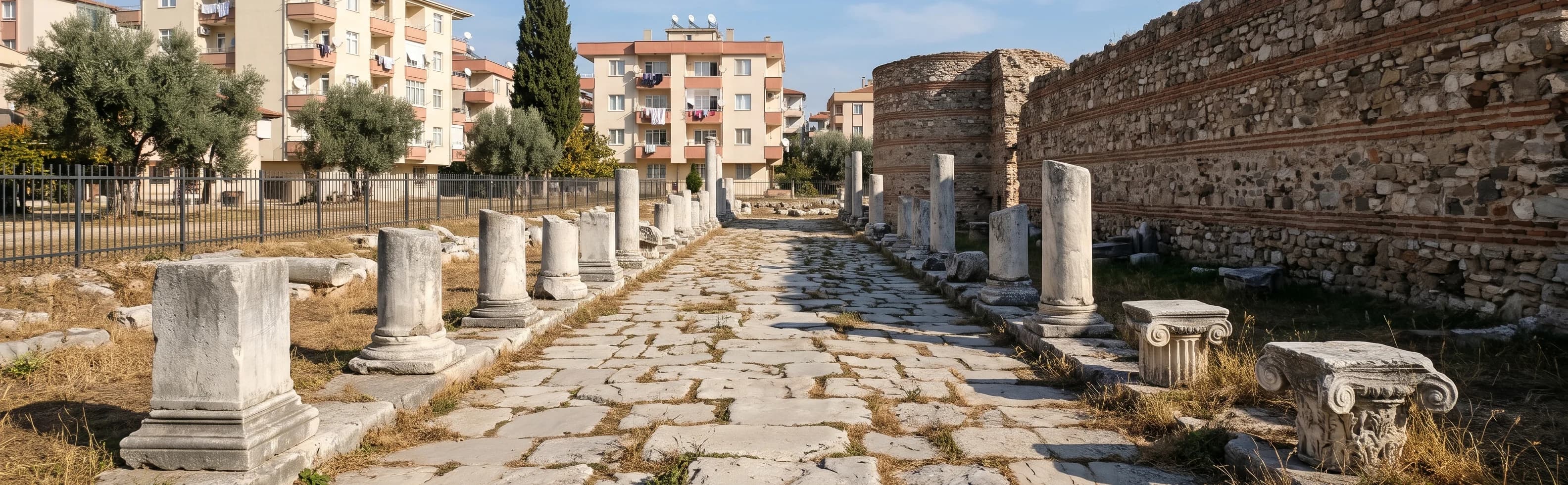
Akhisar is a busy market town in northern Manisa province, and its streets cover the remains of ancient Thyatira, one of the Seven Churches that receive a letter in Revelation. In a city block at its center, the Tepemezarı archaeological park shows a Roman colonnaded street and the tall walls of an apsidal basilica, surrounded by shops and apartments. Elsewhere in town, the Akhisar Museum displays finds from the surrounding plain, from Copper Age marble idols to Lydian gold. Olive groves cover much of the district, which ranks among Turkey's leading olive producers. Below, you will find Thyatira's history, what to see today, and how to fit Akhisar into a Seven Churches route.
Explore Ephesus, Smyrna, Pergamum, Thyatira, Sardis, Philadelphia and Laodicea - the ancient wonders of the Seven Holy Churches of Asia as mentioned in the Book of Revelation.
Check availability
People have lived on the low mounds of the Akhisar plain since prehistoric times, and excavations at Hastane Höyüğü, the Hospital Mound, have reached Neolithic and Early Chalcolithic levels. Ancient writers recorded earlier names for the town, including Pelopia and Semiramis. Its later name took hold in the early 3rd century BC when a Seleucid king settled Macedonian soldiers here as a military colony on the uneasy border between Lydia and Mysia.
Thyatira owed its growth to its position on the road linking Pergamon with Sardis, in a fertile valley watered by the Lycus, now the Gördük stream. Earthquakes struck the town several times, and Roman emperors including Tiberius and Hadrian helped rebuild it. By the 2nd century AD, Thyatira had become a prosperous provincial city with paved streets, porticoes, and public buildings, most of which now lie beneath modern Akhisar.
The main visible remains occupy a single city block in the Ragıpbey neighborhood, a short walk north of İsmail Bahri Bey Avenue. The area was once a hilltop cemetery, which gave Tepemezarı its name. Excavations began here in 1962 under Yusuf Boysal, continued in the late 1960s, and resumed in 2011 under Engin Akdeniz.
A north–south Roman colonnaded street, nearly 10 meters wide, forms the site's backbone. Column bases, shafts, and Ionic capitals from the 2nd century AD line its course. Beside it stand the walls of a long apsidal building about 10 meters wide and more than 40 meters long, with masonry still rising 4 to 5 meters in places. Archaeologists date its use from the Roman period into the 6th century, and many describe it as a basilica. Its southern end disappears under a modern street, reminding visitors how much of Thyatira remains unexcavated.
The park is compact, and a slow circuit along the paths takes less than an hour. Information panels explain the main structures, and from the walkways you can see both the ancient paving and the apartment blocks that hem the site in.
North of the park, the colonnaded street once ran toward Hastane Höyüğü, a mound that served as the town's acropolis and later as a cemetery. In 2019, excavators announced the discovery of a Hellenistic temple on its summit: a rectangular building of roughly 500 square meters with traces of Ionic architecture. Later research dated its construction to the 2nd century BC and showed it was built of dark volcanic stone clad in marble, repaired twice under Rome, and used until the 5th century AD.
More trade guilds are known from Thyatira than from any other city in the Roman province of Asia, with most recorded in inscriptions. Wool and linen workers, dyers, tanners, leather workers, potters, bakers, and bronze-smiths all had their own associations. Textiles and cloth dyeing were especially important to the local economy.
This commercial world forms the background to the letter to Thyatira in Revelation 2:18–29. The longest of the seven letters praises the church's love, faith, and patient service and warns against a self-styled prophetess, Jezebel, who led believers into immorality and eating food offered to idols. The Book of Acts adds another link: Lydia, a businesswoman from Thyatira, met the apostle Paul in Philippi in Macedonia and was baptized there with her household. For Christian travelers, these passages make Akhisar a regular stop between Pergamon and Sardis.
Opened in 2012 inside a school building from 1932, the Akhisar Museum gathers finds from across the district in a single-story building. The archaeology hall begins with fossils from the Soma coal basin and marble idols from Copper Age workshops at nearby Kulaksızlar. It continues with Early Bronze Age vessels from the cemetery at Yortan and gold and silver objects from a Lydian burial mound at Gökçeler. Roman and Byzantine glass, jewelry, and gravestones follow, along with coins struck at Thyatira.
The ethnography section turns to Akhisar's more recent past, covering tobacco farming, carpet weaving, coffee and bath culture, tinsmithing, felt making, and saddlery. Together, the two halls provide useful context for the ruins, so the museum makes a natural second stop in town.
The Turkish name Akhisar means "white castle," following the Byzantine Asprokastro, after the pale towers that once stood on the town's hill. The Saruhan beylik took the town in the early 14th century, and it later became an Ottoman district center. The Aynalı Mosque stands on the site of a Byzantine church, though the current building dates to a 1958 reconstruction. The Zeynelzade library, founded in 1798, stands near the Hashoca Mosque.
Today, Akhisar is better known for farming than tourism. Olive groves spread across the surrounding hills, and the district is one of Turkey's main sources of table olives and olive oil. Tobacco was once its most famous crop and still features in the museum displays. The town has also hosted an olive harvest festival in autumn.
Akhisar lies on the main road north from Izmir toward Balıkesir, and buses from Izmir and Manisa run throughout the day. The bus trip from Izmir takes about two hours. Some TCDD trains from Izmir's Basmane station also stop at Akhisar, but the station is outside the center, so allow time for a taxi or bus into town.
Many visitors combine Akhisar with other churches of Revelation. Thyatira sits between Pergamon to the northwest and Sardis to the southeast, so it fits naturally into a day that continues to Sardis and its Temple of Artemis. A full Seven Churches route takes several days and also covers Smyrna, Ephesus, Philadelphia, and Laodicea.