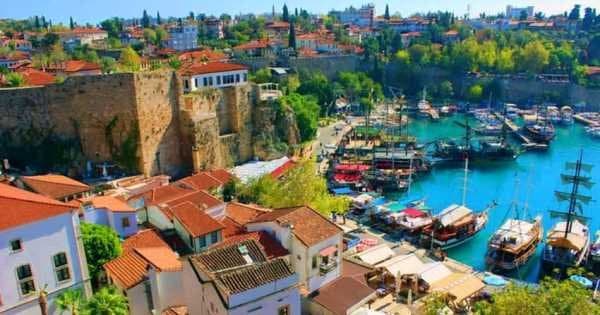
Istanbul is the only city in the world astride two continents Asia on the East and Europe on the west, situated at the entrance of the Bosphorus linking Marmara to the Black Sea.
Although no longer the capital city, Istanbul is still, however, the most important social, intellectual, as well as commercial and industrial centre and also an incomparable heaven for tourist.
Without a doubt, Istanbul is the only city in the world which combines its incomparable natural beauty with intact masterpieces of many different civilizations. The private Istanbul tours are organised to show you the most relevant and accessible sights first so that you can see as much as possible in even a short time. But if you have a week, you should be able to see just about everything described here.
On Private Sightseeing Tour in Istanbul see the Amazing Maiden Tower at the opening of the Bosphorus said to have been built in the time of Constantine this is a must see tour. Also called the "Leander Tower", the legend of the tower is known around the world and refers to Constantine and his daughter.
Emperor Constantine had a beautiful girl, and a sorcerer told the emperor that his daughter would die from a snake bite. To save his daughter from her unfortunate destiny, the emperor built this tower in the middle of the sea, and his daughter started living there.
One day, a basket of grapes was sent to the tower, inside of which a snake crawled out and killed the girl, the prophecy had been fulfilled, and from that day the tower came to be known as the "Maiden's Tower" and one of the best highlights on a private tour of Istanbul Turkey.
Travel Tips for Istanbul
You can travel to Turkey at any time of the year due to the great annual climate and of course high season is best due to the hot temperatures, however, travelling out of season is still a good time to visit the many historical sites around the country. It can be chilly and a little wet from January to the start of April, but it is tolerable. Flights are cheaper out of the summer season as is the accommodation and private tours so pre-book if you can.
Turkey is the ideal holiday to suit any budget! The flights can be reasonable, and you can visit turkey any time of the year! The currency is Turkish Lira, but they accept all currencies so don't worry. You are best changing money in Turkey as you get a better rate than you would do back home. The bars and restaurants great, they cater for all pallets and are extremely reasonable. If you love shopping, you can get fantastic bargains.
Turkey is a very diverse country, and the locals are most welcoming and very helpful, you will fall in love with the magic in this country, and will keep coming back for more. If you like to shop and get a bargain, then this is the place for you; haggling is part of the culture so have fun but do not go crazy take around 30% off their asking price! The buses are frequent and cheap, and meters are fitted in all taxi's.
The weather is super for most of the year, and the winters are not very cold. From May to November the weather is fantastic, but from July until September it is scorching with temperatures rising to 45 degrees. There is air conditioning everywhere so if you do not want to lie on a beach; there is so much to do and see here you will have a fabulous time.
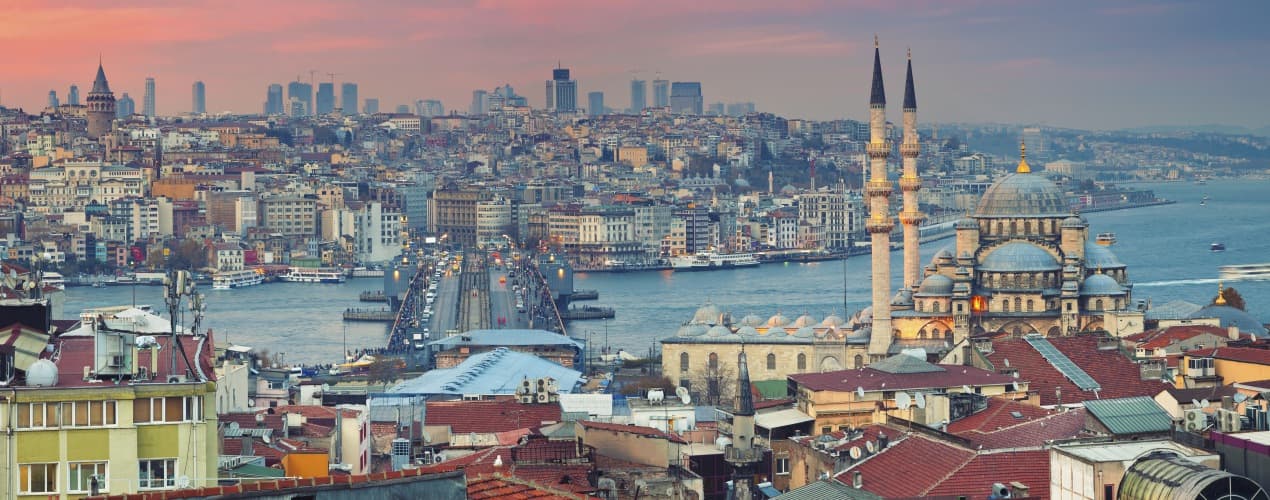
In private tours Istanbul first thing, you'll be impressive the skyline of the old city. It will take you at least three days to get around and see the major sights. You can easily spend a week at it, for Istanbul offers an awful lot to see.
Istanbul, largest city of Turkey, is so rich in historical and artistic resources and offer such a beautiful diversity that one should first read volumes about it, a task when a tourist can hardly be expected to accomplish. It is, however, desirable to run through one of the comprehensive guides of the city, such as for example those of Mamboury or Malcolm Burr.
Istanbul is the only city in the world astride two (continents Asia on the east and Europe on the west, tuated at the entrance of the Bosphorus, linking the a of Marmara to the Black Sea, it is one the main keways to Turkey. Although no longer the capital city, Istanbul is still, however, the most important social, intellectual, as well as commercial and industrial center and, in addition an incomparable heaven for tourist.
Explore the Top 15 Things to Do in Private Istanbul Tours
- Topkapi Palace
The first stop on any visitor's sightseeing list is where the Ottoman sultans, their dozens of women, and their hundreds of servants lived and worked. The ancient Seraglio, one of the most romantic palaces in the world.

Fatih Sultan Mehmet had it built during the years 1465 to 1478. After Fatih, different rulers made various additions, and thus it increased in size until the XlXth Century. It stands on one of the seven hills of Istanbul.
The Topkapı Palace, considered to be one of the most important architectural systems including its surroundings, was converted into a museum after the declaration of the Republic. It has an archive where documents and certificates of high historical importance have been collected together. The thrones belong to Ahmet the And, Murat the IVth, and Selim the 1st.
The Harem section and the Baghdad Kiosk built on the orders of Murat the IVth in the XVIIth century after his return from the war at Baghdad are masterpieces of architecture and tile decoration. All the walls of these building are covered with tiles. Harem is the real highlight of the Topkapi Palace in your private tour of Istanbul.
- Hagia Sophia
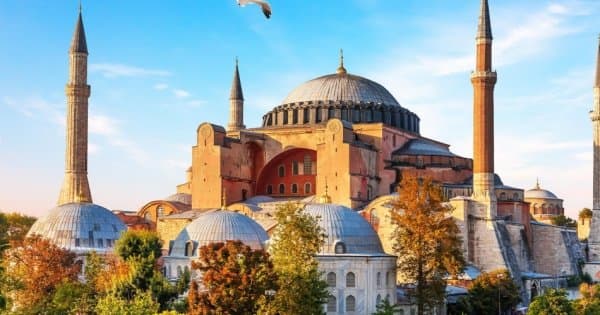
Dominating the area of the Hippodrome is the massive pale-yellow Church of Hagia Sophia(in Turkish, Aya Sofya), built in the 6th century as the grandest cathedral in Christendom, later converted to a mosque. In 1935 religious character was removed and it became a museum.

The original construction was the work of the Emperor Justinian, one of Byzantium's most famous rulers for three reasons: the reconquest of much of the Roman Empire that had been lost to barbarians, the building of Hagia Sophia, and the bankrupting of the empire. The cathedral was one of his grandest construction projects and contributed significantly to the latter. Construction was finished in 548, and the emperor inaugurated the church as the "Eye of the Universe" by entering and exclaiming, "Oh Solomon, I have outdone thee!"
Once you're inside, don't miss the mosaic over the first doorway you come to, one of the best-preserved mosaics in the museum As you enter the narthex, there are rows of doors on either side. On the left are the doors to the outside these were the original front doors to the church. On your right, the doors into the sanctuary include an enormous central one for the exclusive use of the emperor. Note the holes made by the feet of his guards, standing by the doors over the centuries, just inside the threshold. Again, don't miss the mosaics over these doors.
To appreciate the architects' genius, enter the great Hagia Sophia church slowly, looking through the emperor's Imperial Door into the sanctuary. Walk slowly and notice the first semi-dome open above, then another semi-dome, then the great dome held, as it were, "by a great chain suspended from heaven." St. Peter's in Rome is the only church which comes to mind for comparison, but remember that Hagia Sophia's 1,000 years older.
The feeling of great age and history is all around. Mosaics of saints look down from high above; there's a special loge for the sultan which he could enter and leave without being seen; the mihrab is not centered in the apse because it must point directly toward Mecca; imagine what it must have been like with all of the cup-like glass oil lamps lit, in the chandekers, on the walls, around the dome; clap your hands and listen to the sound echo through the room for minutes. Hagia Sophia is the highlight of the Istanbul sightseeing tours.
- Blue Mosque
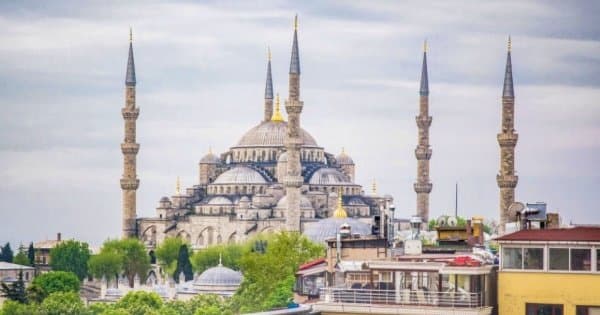
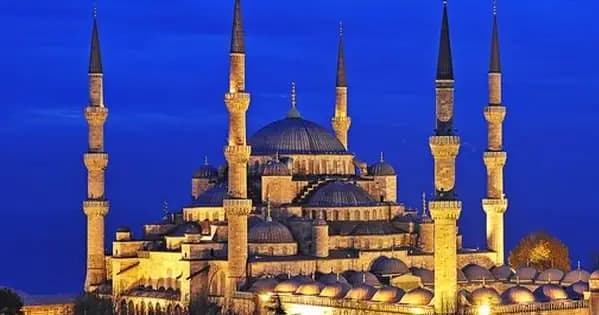
Literally a stone's throw away from Hagia Sophia is the magnificent Blue Mosque, the Mosque of Sultan Ahmet I, built during ten years of work at the beginning of the 17th century. The sultan wanted his mosque to rival, if not surpass, the glory of Hagia Sophia, so he built it where all could compare the two. The Blue Mosque wins by a mile, but only because the Hagia Sophia parison is grossly unfair. The 350-year-old mosque is a young upstart compared to its ancient neighbor.

Go through the courtyard to the fountain where Muslims are washing hands and feet before prayer, and then take off your shoes before stepping on the mosque's precious carpets. For women whose clothing doesn't meet strict standards, there are robes available at the entrance, free of charge.
Inside you'll see that the Blue Mosque gets its name from over 21,000 pieces of faience with which the walls are covered. The many windows, the painting on the ceiling, and the color of the tiles give the mosque an airy quality that's ruined only partially by the massive pillars the architect found necessary to hold up the dome (compare the architecture of Hagia Sophia).
On the way out, notice the ramp to the right of the "tourists' entrance." There's a story that Sultan Ahmet had a ramp rather than steps built here so he could ride his horse all the way up to the door of the Imperial Box in the mosque. The six minarets of the Blue Mosque caused some consternation in the Muslim world for a while, especially in Mecca, where local Muslims forced the sultan to add another minaret to the six of the Elharam Mosque's collection so that this very holy place would not be outdone. Blue Mosque is the must see second place in your Istanbul tour.
- Basilica Cistern
Across the street from Hagia Sophia, under a little park on Divan Yolu, is the Cistern Basilica (Yerebatan Saray in Turkish the Sunken Palace). You can walk downstairs and out onto a platform built above the water. Try to remember the scene from the film From Russia With Love, where the action is in a boat floating toward a periscope through an underground body of water.

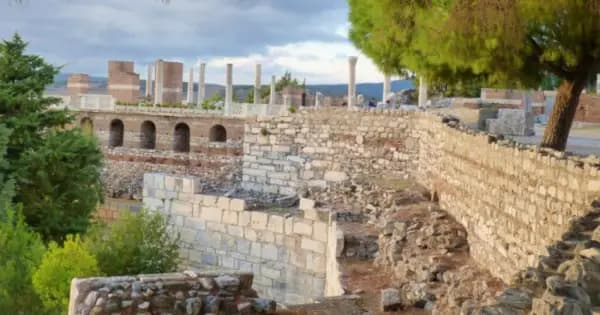
Filming for that part of the movie was done here, though there's no longer any periscope and the Russian Consulate is in Beyoğlu. The view of this Basilica Cistern, built by Justinian, with its 336 columns, is well worth the small amount you must pay to get inside in your Istanbul private tour.
- Hippodrome of Constantinople
Outside again, walk across the Blue Mosque from the obelisks on the mall. The mall is really the old Hippodrome, one of the oldest constructions in the city, dating from before the time of Constantine. The first object you pass is a fountain pre Hagia Sophia send by Kaiser Wilhelm II of Germany to Sultan Abdul Hamid II. Next, one of the most interesting decorations in the Hippodrome, an obelisk dating from the 15th century B.C., originally in Egypt, brought to Constantinople by the Emperor Theodosius his figure is carved on the pedestal which supports the obelisk and erected in A.D. 390.

The obelisk is thought to have been much taller than it now is, even three times as tall. It was commissioned by Thutmose III to commemorate his conquest of Syria. Beside the obelisk is the Serpentine Column, another of the city's oldest monuments, also pilfered from a temple, this time from Delphi, where it had stood since the 5th century B.C. until Constantine brought it to the city. OrigiHagia Sophianally it was higher and had three snakes' heads at the top.
The last monument in the Hippodrome is the Obelisk of Constantine a rough stone column once covered with bronze plates. The bronze disappeared a long time ago, probably going the way of all valuable metals in a declining Hagia Sophia made into cannons and coins. Another story goes that the Crusaders when they captured the city in 1204, thought that the obelisk was covered in gold, and fell over one another trying to get at it.
At any of these three monuments, it is easy to see the original level of the Hippodrome, a few feet below the present surface.
- Turkish and Islamic Arts Museum
Facing the Blue Mosque across the Hippodrome is the Palace of İbrahim Pasha, built in 1524. The palace now houses the Türk ve İslam Eserleri Müzesi, the Museum of Turkish and Islamic Arts. The historical exhibits on the upper floor date from the time just after the founding of Islam (A.D. 700s), and continue through the Ottoman Empire, which ended in 1923.

You'll see here the most beautiful examples of Ottoman decorated wooden Koran holders and Koran stands, exhibits of calligraphy (one of the finest arts in Islam), Turkish miniatures, illuminated manuscripts, and fine antique Turkish carpets. On the lower floor are ethnographic exhibits, including a black camel-hair nomadic tent, furnished with a nomad family's regular daily needs, and also with an explanation of the nomadic lifestyle, in English. Turkish Islamic Arts Museum must see 6th place of tours in Istanbul.
- Istanbul Archaeology Museums
The Archeological Museum houses a huge collection of statuary, inscription stones, sarcophagi, mosaics, and so forth, much of it displayed to advantage. Upon entering, go to your left and in the center of the first room notice the sarcophagus once thought to be that of Alexander the Great. It's in astoundingly good shape after being around for more than 2,000 years.

In fact, some of the original paint is still in its figures. A diagram on the wall near the other doorway will show you how carefully the sarcophagus was buried, the reason for its exceptional preservation. In the other wing on the ground floor don't miss the sarcophagus of Tabnit, King of Sidon, with the king himself beside it. The sarcophagus looks almost brand-new. The king, after nearly 3,000 years, does not. The king liked the sarcophagus so much that he dumped its former occupant out and had himself interred, and this is where he's been since the 6th century B.C.
- The Grand Bazaar
This is a city in itself inside the city proper. The number of streets inside it is countless. It is recommended that a foreigner visiting the city should, at any rate, stop by to see the Grand bazaar. Inside it there are fountains, mesjids (small mosques), and everything else to serve the daily needs of those that stay inside ali day. The place called «Bedesten» has inside it a dome and a high ceiling. Grand bazaar is the must see the eighth highlight of the 15 things to do in Istanbul tour.

The interior part of it suggests the gloomy, mediaeval type of building. Formerly, this was the place where jewellery was sold. Today, antique things and different kinds of weapons are kept and sold here. This is the oldest section of the bazaar. It was built in 1461 by order of Fatih Mehmed. The rest of the Grand bazaar was founded by Sultan Süleyman in the XVIth century. The bazaar has many gates. On each street only one type of tradesman dwells. This is a tradition that goes back many centuries. The bazaar, destroyed several times by fire, took its- present shape in 1898.
- Dolmabahçe Palace
The building, constructed in 1854 during the reign of Sultan Abdulmecit, is known as one of the most majestic palaces built in the XlXth century. It is situated on the shore from which it takes its name. This shore has been filled up with piled-up soil. With it's white silhouette and it's magnificent hall in the middle, it has an impressive beauty. The palace, and the mosque beside İt which belongs to the same era, resemble a small city.

Every part of the mosque was built and decorated with great care. Even the gardens were arranged very elaborately. Many foreign masters were invited to help decorate it and a great number of statues, paintings and pieces of furniture were brought along with them. It is said that the size of the reception room is unequalled and that the massive chandelier, which is known to be a gift of Queen Victoria, is matchless.
Ornamental vases from Sevres are used in adorning the halls. From the point of view of architectural style, it is influenced by the ancient Turkish mansions. The builders of the palace did not spare any expense, and in some places, have gone so far as to put up railings of crystals on the staircases. The Turkish bath inside made out of oriental verdantique is very famous. The section owned by the heir to the throne has now been turned into a museum of paintings and statues. In the hall, the paintings of noted artists are hung on the walls. These were bought and brought home by Sultan Abdülaziz on his trip to Europe. Kemal Atatürk, the founder of the Turkish Republic, died here in 1938. You should definitely not miss Dolmabahce Palace in your private tours of Istanbul.
- The Spice Bazaar
It is the most widely known building of its kind after the Grand Bazaar. It is included in the complex of the New Mosque and is situated on the South-Western side of it. Thé bazaar took this name since it is a place where spices are sold. It was built in 1660 along with the New Mosque and consists of one L-shaped street with shops crammed at the sides of the street.

It has six entrances. Inside, there is "Pandelli", a very typical Turkish restaurant, you can enjoy in your tours of Istanbul.
- The Maiden's Tower
Legends exist about the name and foundation of this tower. It is at the opening of the Bosphorus and is said to have been built in the time of Constantine and at his own wish. It is known to have been used first as a signal-tower and was very important in that İt assured the security of the Bosphorus.

The Turks rebuilt it and gave it a very attractive appearance making it a light-house this time, but it was burnt down in a fire started by an oil lamp one night because the upper part of the tower was made of wood. After that, it was built for the third time during the reign of Ahmet, the 3rd. (XVIIIth century), this time from masonry. The historians note that chains used to be tied to the tower and the shore during the Byzantine period.
The legends about the tower are known round the world. It is also called the "Leander Tower". One of the legends is about Constantine and his daughter.
Emperor Constantine had a pretty daughter. A sorcerer told the emperor that his daughter would die from a snake bite. To save his daughter from her unfortunate destiny, the emperor built this tower in the middle of the sea and the daughter started living there. One day, a basket of grapes was sent to the tower from the inside of which a snake crawled out and killed the daughter. The prophecy had been fulfilled and from that day the tower came to be known as the "Maiden's Tower". The tower is one of the best highlight of the private tour of Istanbul.
- Galata Tower
The saying goes that this was the spying-tower of the Galata ramparts built by the Genoese. It used to have a pointed cap on it when it was owned by the Turks but later in the XlXth century; it adopted its present shape. Fatih Mehmet had sent his fleet over the ridge that stood above the tower and had landed İt on the Golden Horn.

Today, the Galata Tower is looked upon Galata and İstanbul to prevent the entry of the fleet to the Golden oHrn. Today, the Galata Tower is looked upon as a typical spy-tower of the Middle Ages. Lately, it has been restored. On the upper floors commanding an extensive view of the Golden Horn and the city, there are a restaurant and a night-club frequented by tourists and the Istanbul society. I you even have an hour in Istanbul jut to feel the istanbul you should definitely not miss Galata Tower in your Istanbul tours.
- Süleymaniye Mosque
It is one of the most beautiful mosques in Islamic architecture. It was built by Mimar Sinan for Kanunî Sultan Süleyman during the years 1550 to 1557. It is a triumph for Mimar Sinan, the great Turkish architect, from the point of view of its situation since the city takes its silhouette from this mosque. The charm of the interior planning, as well as the elegance of the exterior,, take the mosque to the peak of architectural beauty.

Around a big central dome, there are two semi-domes on each side, or rather, five sn.-all domes above each primary platform, thus all the domes converge, giving the place a substantial arrangement. The writings on the windows and on the tiles are considered to be the best examples of their kind found in that era. Around the mosque was built a complex which conformed to the ideal town-planning concept and almost equalled that of the Fatih Mosque. The Süleymaniye Mosque is superior to St. Sophia with regard to its interior and exterior gracefulness and is known as an example of Turkish supereminence.
- Sokollu Mehmed Pasha Mosque
There are several entrances; the main one is on the southwest comer and can be reached by turning left when you enter the small square at the bottom of the hill. Walk up a flight of stairs to get to the courtyard and medrese. There will probably be no one around, in which case just remove your shoes (slippers are provided for your use) and have a look around.

This is one of Sinan's smaller mosques and, I think, one of his more beautiful. It was built for the daughter of Selim II in 1571 and has a definitely feminine beauty, which is not seen in Sinan's other mosques. The wall around the mihrab is all of İznik tiles of very good quality, and with the flower-motif stained-glass windows against stark-white walls, the whole effect is very light and gay.
The area around the mosque is small-town-like, and you will be able to see a bit of Turkish life: women crocheting, children playing, the milkman calling. All in all the atmosphere is very pleasant, dominated, it seems, by the cool presence of the mosque.
- The Golden Horn
A century or two ago a boat trip up the Golden Horn revealed palaces, pleasure kiosks, and imperial gardens on the sides of the city's seven hills. But in this century the romance was swept away as Turkey industrialized. The pleasure gardens were replaced by a motley, ugly collection of coal heaps, shipyards, factories, and workshops.

A few years ago a young and activist mayor of Istanbul named Bedrettin Dalan accelerated clean-up efforts, and today the Golden Horn is lined for much of its length by parks and esplanades. Clean-up of the estuary's waters continues, and a boat trip along the Golden Horn is once again a pleasure of your private tours of Istanbul.