
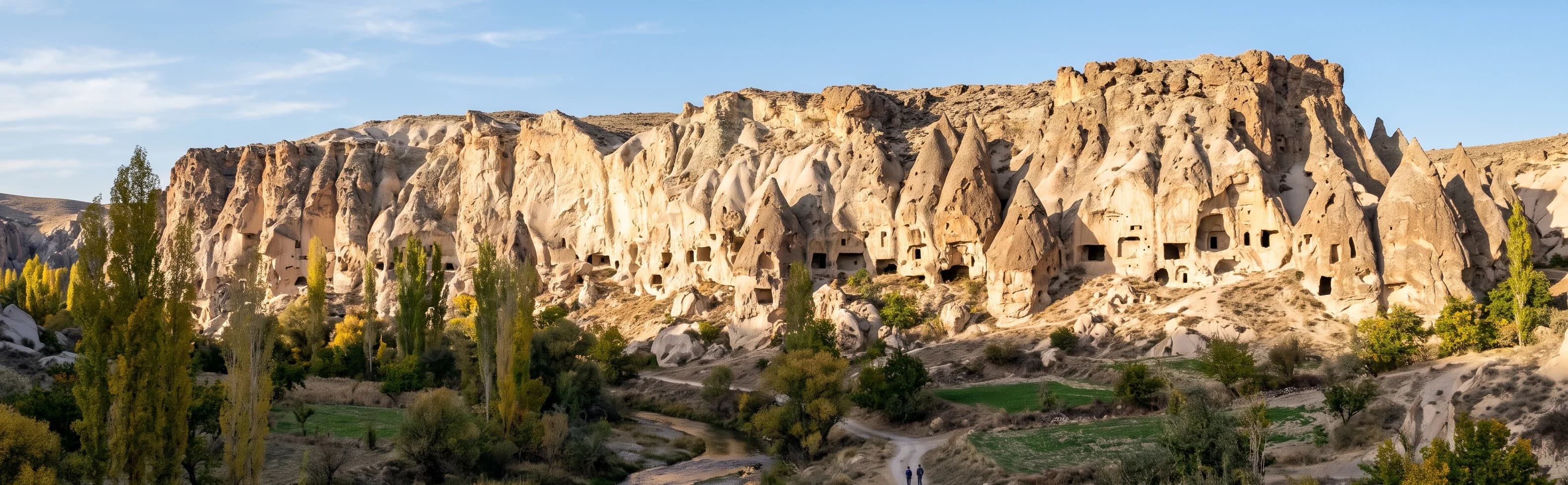
Selime
Selime, a small town in the Güzelyurt district of Aksaray province, stands at the mouth of the Ihlara Valley in western Cappadocia. Its landmark is a huge rock-cut complex in the cliff above the town, often called Selime Monastery or Selime Cathedral. It includes a three-aisled church, a kitchen with a soaring chimney, stables, and courtyards. Below it, a Seljuk tomb with a conical roof stands among cone-shaped volcanic rocks. The valley path follows the Melendiz Stream south toward Belisırma. Here you will find the key sights, how Selime fits with an Ihlara walk, and advice for planning the trip.
Let the activities begin!
No tours match these filters yet. Try another destination or browse all tours.
Where the Ihlara Valley Opens Out
The Ihlara Valley is a deep gorge cut by the Melendiz Stream through the volcanic plateau southeast of Aksaray. At its southern end lies the village of Ihlara; at its northern end, the canyon walls fall away, and the stream runs out past Selime. The town spreads along the road below a long, pale cliff, with tuff cones and rock-cut rooms scattered along its base. Across the stream, the village of Yaprakhisar has more cave dwellings in the same soft rock.
Most travelers reach Selime by road, either as the last stop of an Ihlara walk or as a separate visit from central Cappadocia. It is worth more than a quick bus photo, because the cliff hides a rock-cut building that ranks among the biggest in the region.
The Rock-Cut Complex Above Town
Signs call the site Selime Monastery, Selime Cathedral, or Selime Castle, and each name captures part of it. The complex extends for more than 100 meters along the cliff face, with rooms carved on several levels around two open courtyards. A steep path climbs from the road, and the final approach runs through a long, curving tunnel in the rock.
The church is the main attraction. Carved in the shape of a basilica, it has three aisles separated by two rows of rock pillars, with an apse at the east end. Other halls open off the courtyards, including a large reception room with a high ceiling. The kitchen is striking: a square room whose ceiling narrows like a pyramid into a tall chimney, blackened by centuries of smoke. Near the base of the cliff, you can see stables with feeding troughs cut into the walls.
A hilltop fortress once stood above the complex, and loose stones and rock-cut rooms mark the higher slopes. The ground is uneven, and parts of the site have no railings, so take your time on the upper levels.
Frescoes and the Question of Who Lived Here
Faded wall paintings survive in the church, though soot and erosion have damaged much of them. Specialists date the paintings to roughly the 10th and 11th centuries. Estimates for the carving itself range from the 8th to the 11th century. In the Middle Byzantine period, this part of Cappadocia lay close to the frontier with the Arab caliphate, and many large rock-cut settlements date from that time.
The traditional label of "monastery" is now debated. Some researchers argue that the layout, with formal halls, a grand kitchen, and stables arranged around courtyards, fits a wealthy family's residence better than a community of monks. Others stress its defensive position above the valley mouth. Whichever view you favor, the scale of the rooms shows how much labor went into carving a home this size out of solid rock.
The Selime Sultan Tomb
Near the foot of the cliff, the Selime Sultan Tomb is a stone mausoleum with a conical roof on an octagonal base, an unusual form for a Seljuk tomb, or kümbet, in Anatolia. It most likely dates from the 13th century, when the Seljuk Sultanate of Rum ruled this region. Local tradition connects it with a Seljuk commander who died fighting nearby. It stands among the cone-shaped rocks on the town's outskirts, so you pass it on your way to the cliff.
Walking the Ihlara Valley to Selime
A path follows the Melendiz Stream along the valley, past poplars, small fields, and rock-cut churches. The most visited churches lie near the main stairway close to Ihlara village. From Belisırma, the stretch north to Selime is quieter and more open, and it usually takes two to three hours on foot.
Walking the whole valley in one day is a long outing, so many visitors pick one section and arrange transport at the other end. If you plan to finish in Selime, allow time and energy for the climb up to the rock-cut complex, which is steep in places.
Getting to Selime and Time on Site
Selime is roughly 30 kilometers from Aksaray by road. From the central Cappadocian towns, such as Göreme, the drive is longer, so most visitors come on a full-day trip. Organized day tours from Cappadocia often pair Selime with a section of the Ihlara walk and an underground city.
Allow one to two hours to explore the complex and the tomb at an easy pace. The site has its own ticket office and charges an entrance fee, so check current prices and opening hours on the Turkish state museums website before setting out.
When to Visit
The mild weather from April to June and from September to October suits climbing and walking best. Summers on the plateau are hot and dry, and the cliff offers little shade at midday, so come in the morning or toward evening. Winters are cold, and snow or ice can make the rock paths slippery. The late-afternoon sun lights up the cliff face beautifully, and the town is calm after the tour groups leave.