
Erzurum
Erzurum sits on a high plateau in eastern Turkey, about 1,900 meters above sea level, making it one of the country's highest and coldest cities. For centuries, it guarded the road between Anatolia, the Caucasus, and Persia. Its compact center still shows that history in Seljuk madrasas, domed tombs, an old citadel, and Ottoman mosques. In winter, the slopes of Palandöken rise just south of town. Summer opens the Tortum Valley to the north, with its waterfall, lake, and Georgian monasteries. Erzurum suits travelers who want architecture, mountain scenery, skiing, and hearty local food away from coastal crowds.
Let the activities begin!
No tours match these filters yet. Try another destination or browse all tours.
A Frontier City on the High Plateau
In the late 4th century, the Romans named the town Theodosiopolis after Emperor Theodosius I and fortified it as a frontier post. Arab writers later called it Kālīkalā. After the Battle of Manzikert in 1071, Turkish rule began, and the Saltukid dynasty governed the city until the early 13th century. The Mongols sacked it in 1242, and the Ottomans took control in 1514. Russian forces captured Erzurum in February 1916 and held it until 1918.
The city also has a central place in modern Turkish history. In the summer of 1919, Mustafa Kemal (later Atatürk) chaired the Erzurum Congress, which opened on 23 July 1919. Its delegates drafted an early version of the National Pact, a founding text of the independence movement. The house where Mustafa Kemal stayed during those weeks is now the Atatürk House Museum.
Madrasas, Tombs, and the Citadel
Most of Erzurum's historic monuments lie close together along Cumhuriyet Avenue and the streets around the citadel. The Çifte Minareli Medrese (Double Minaret Madrasa) is the city's emblem. Two fluted brick minarets frame its carved stone portal. Inside, a courtyard is surrounded by four iwans and student rooms. It dates to the second half of the 13th century, though scholars still debate its exact date and patron. A large twelve-sided tomb stands behind it. The Ulu Cami (Great Mosque) next door was completed in 1179 under the Saltukids. Its broad prayer hall rests on rows of heavy stone piers.
A short walk away are the Üç Kümbetler (Three Tombs), a group of conical-roofed mausoleums. The largest is attributed to Emir Saltuk and dates to the 12th century. The two smaller tombs are probably later, and no one is certain who was buried in them. Nearby, the citadel occupies the highest ground in the old city. Its Tepsi Minaret now serves as a clock tower. The walls offer views across the rooftops to the surrounding mountains.
Yakutiye Madrasa and Ottoman Erzurum
Built in 1310 by Hoca Yakut, the local governor of the Mongol Ilkhanids, the Yakutiye Madrasa stands out for its tile-decorated minaret and its finely carved stone portal. Today it houses the city's museum of Turkish-Islamic art and ethnography, with objects from Erzurum and the surrounding region. Close by, the Lala Mustafa Paşa Mosque was built in 1562 by an Ottoman grand vizier. Its plan follows Istanbul's classical mosques, and it ranks among the city's earliest Ottoman mosques.
For shopping, head to the Rüstem Paşa Caravanserai, known locally as Taşhan. Built around 1561, this stone inn now houses workshops and stores that sell jewelry and prayer beads made from Oltu stone. This black, polishable jet is mined near the town of Oltu, northeast of Erzurum, and is a typical local souvenir.
Winter at Palandöken
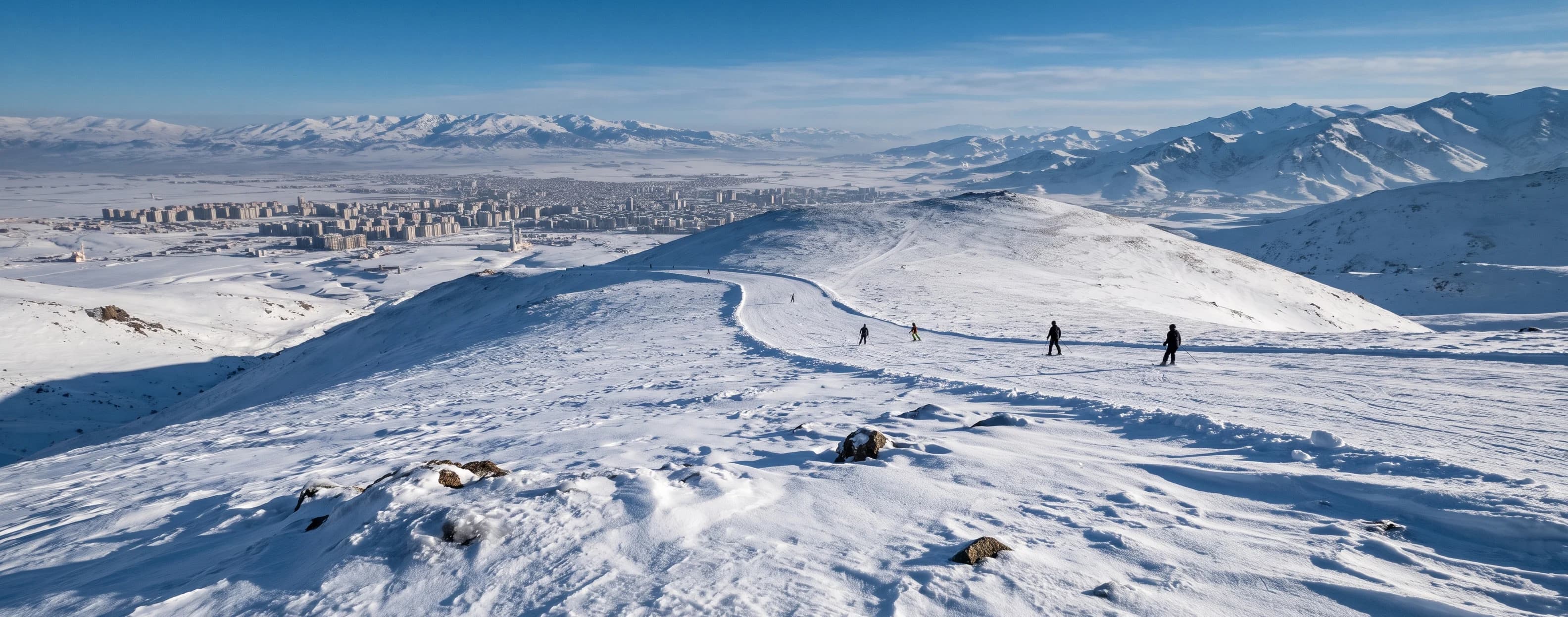
Palandöken ranks among the country's leading ski resorts. Its lifts start only a short drive from the city center. The slopes rise from about 2,200 meters to more than 3,100 meters. The longest run measures about 12 kilometers. The resort hosted events of the 2011 Winter Universiade. The best skiing usually runs from mid-December into April. The upper slopes can stay open later in snowy years. Erzurum also has a second ski area at Konaklı. Even if you do not ski, a gondola ride offers broad views over the Erzurum plain.
Tortum Valley, Uzundere, and Georgian Monasteries
About 100 kilometers north of the city, the road follows the Tortum River into a deep valley of orchards and rocky slopes. Tortum Lake formed when a landslide blocked the river. The water now leaves the lake over Tortum Waterfall. At about 48 meters high, it is Turkey's tallest waterfall. Since a hydroelectric dam was completed in 1960, much of the water has been diverted to turbines. The waterfall is at its fullest only in late spring, usually around May and June. It can be thin for the rest of the year. Viewing platforms and stairs lead down beside it.
The nearby town of Uzundere belongs to the Cittaslow movement of small "slow cities," and its milder microclimate supports fruit growing. In the village of Çamlıyamaç stands Öşk Vank (Oshki), a 10th-century Georgian monastery dedicated to St. John the Baptist. It was once an important center of Georgian manuscript writing, and its large stone church still stands above the village. A day trip that combines the lake, the waterfall, Uzundere, and Öşk Vank works well from Erzurum, though the roads are winding and travel times are longer than the distances suggest.
Food in Erzurum
Erzurum's best-known dish is cağ kebabı. Marinated lamb is stacked on a horizontal spit and roasted beside a fire. The cook slices it off in thin layers onto small metal skewers, which are served with lavash bread. It comes from the Oltu area, and "Erzurum Oltu Cağ Kebabı" has carried a geographical indication since 2010. Hearty soups and stews suit the long winters, and many restaurants serve them alongside grilled meats. Tea houses near the old monuments are a pleasant place to warm up between visits.
Getting to Erzurum
Erzurum Airport, a short drive from the city, has daily flights from Ankara and Istanbul, making it the quickest way to arrive from Istanbul. The city is also a stop on the Eastern Express (Doğu Ekspresi), the long-distance train line between Ankara and Kars. In winter, the Touristic Eastern Express runs the same route and stops in Erzurum for a short city tour. Intercity buses connect Erzurum with most cities in eastern Turkey. For the Tortum Valley and other rural sights, road travel with your own vehicle or a hired driver is the most flexible option.
Planning a Visit and Nearby Destinations
Erzurum fits naturally into a longer journey across eastern Turkey. Two days allow time for the historic center, a museum visit, and an evening of cağ kebabı. Add a third day for the Tortum Valley, or several days in winter if you plan to ski. From Erzurum, many travelers continue east to Kars, the gateway to the medieval ruins of Ani, or toward Ağrı, home of Mount Ararat. Erzurum is also a convenient stop between the Black Sea coast around Trabzon and the Anatolian interior.