
Karahantepe
Karahantepe is a Neolithic site in the Tek Tek Mountains of Şanlıurfa province in southeast Turkey, about 55 kilometers by road east of the provincial capital. More than 11,000 years ago, its builders cut rooms directly into the limestone, carving a human head out of the bedrock and shaping stone pillars that still stand where they were made. Archaeologists often call it a sister site to Göbekli Tepe. New finds announced almost every season have made it one of the most closely watched digs in the Near East. Here is what you can see, how to reach the site, and how to fit it into a trip around Şanlıurfa.
Let the activities begin!
No tours match these filters yet. Try another destination or browse all tours.
A Village of Stone Before Farming
Archaeologists first recorded Karahantepe in 1997 during an archaeological survey, but excavation began only in 2019. An international team led by Istanbul University has worked here since then as part of the Şanlıurfa Neolithic Research Project, better known as Taş Tepeler ("Stone Hills"), which studies about a dozen early sites spread across the province. Locals also know the hill as Keçilitepe.
According to the excavation director, Professor Necmi Karul, people began building here around 9400 BCE and used the site into the 8000s BCE. Over that time, their buildings changed shape: the earliest are round, later ones have rounded corners, and the latest are fully rectangular. Only a small part of the hill has been dug so far; much of the settlement still lies under the surface.
The Rock-Cut Chamber and the Stone Head
The best-known spot at Karahantepe is a small chamber cut about 3.5 meters down into the bedrock. A human head projects from one wall and gazes across the room toward a row of pillars carved from the same bedrock. Archaeologists read the space as a ritual setting, possibly linked to rites of passage, rather than a home.
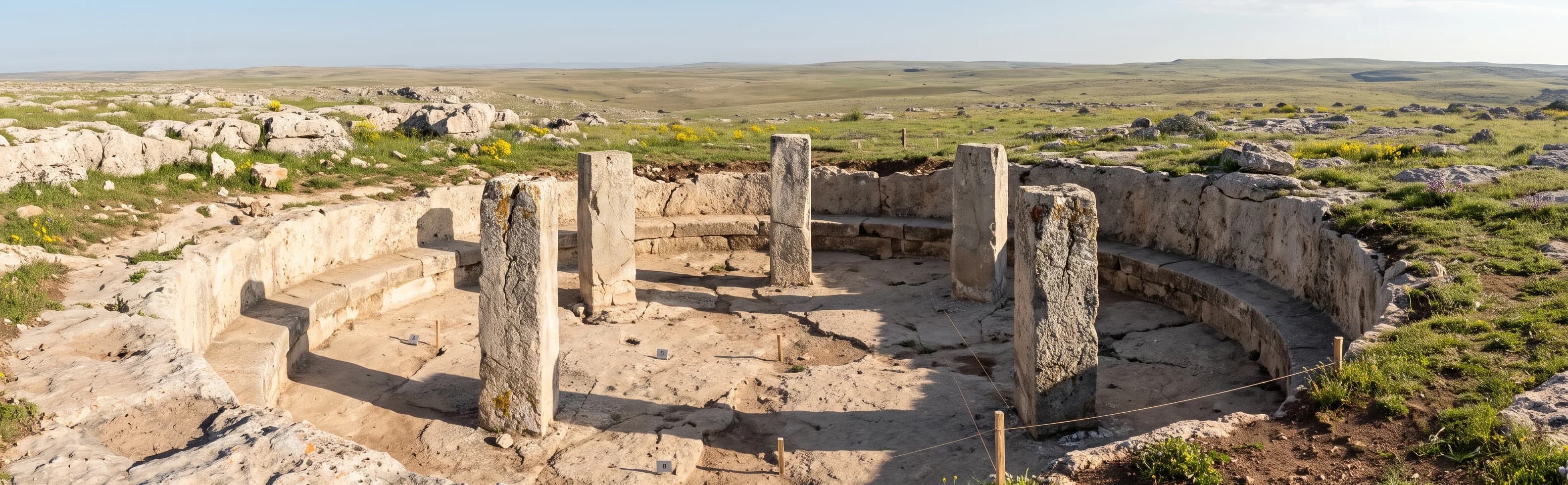
Next to it lies a much larger round building, about 23 meters across on the inside. Stone pillars break up its wall; two more stand at the center, and a low two-step bench runs around the edge. Elsewhere on the hill, T-shaped pillars carry carved arms and hands, the same stylized human figures seen at Göbekli Tepe.
Carved Faces and a Ring of Benches: Recent Finds
In 2025, the team found three T-shaped pillars inside a house rather than a public building. One of them, about 1.3 meters tall, has a human face carved on its side, the first pillar of this kind found in the area. Pillars inside homes are smaller than those in communal buildings and helped hold up the roof while also carrying symbolic meaning.
Later that year, excavators announced a round structure about 17 meters wide, with three broad, tiered benches facing a sculpted focal point. They compared the layout to a small amphitheater. Its builders set human heads into the walls, and excavators found seated human figures on the floor. Restorers plan to re-erect its fallen pillars once conservation is complete. Because digging continues each season, the areas on view may differ from year to year.
Visiting Karahantepe Today
The site sits on a bare limestone hill inside Tek Tek Mountains National Park, a dry plateau between the Harran and Viranşehir plains. The official museum portal of Turkey's culture ministry lists it as open every day. In 2026, landscaping, protective roofing, and a visitor welcome center were still being completed under the ministry's Heritage for the Future project. Paths and facilities may differ from older photos. Check current hours and access before you set out.
Expect to see the buildings from set paths around their edges rather than from inside, as the trenches are part of an active excavation. Shade is scarce on the hilltop. Carry water and a sun hat, and choose footwear that handles loose, uneven ground. A guide or a good site plan helps because the carvings make more sense when you know what to look for.
Getting There
Karahantepe lies in the Haliliye district, east of Şanlıurfa, and the last stretch crosses open country with few services. The simplest options are a rental car, a taxi hired for a few hours, or an organized excursion from the city. The nearest airport, Şanlıurfa GAP, is served by direct flights from Istanbul and Ankara, and intercity buses link Şanlıurfa with Gaziantep, Mardin, and other cities in the region.
Pairing Karahantepe with Göbekli Tepe and the Museum
Many visitors see Karahantepe together with Göbekli Tepe, its better-known neighbor, which UNESCO inscribed in 2018. The two make a long but rewarding day by car. One sensible order is to start at the Şanlıurfa Archaeology Museum, where the "Karahantepe and Neolithic Human" exhibition has displayed finds from the site since 2021, then visit Göbekli Tepe before finishing at Karahantepe.
If you have extra days, consider Harran's beehive houses on a separate day or continue north to Adıyaman for the stone heads on Mount Nemrut, a monument from a much later era.
When to Go
Spring and autumn bring the most comfortable conditions. From April to early June, the plateau is briefly green, and temperatures are pleasant for walking. September and October are dry and warm but no longer scorching. Summer heat on the exposed rock can be fierce by late morning, so arrive early if you come between June and August. Winters are cool, and showers can leave the unpaved areas muddy.