
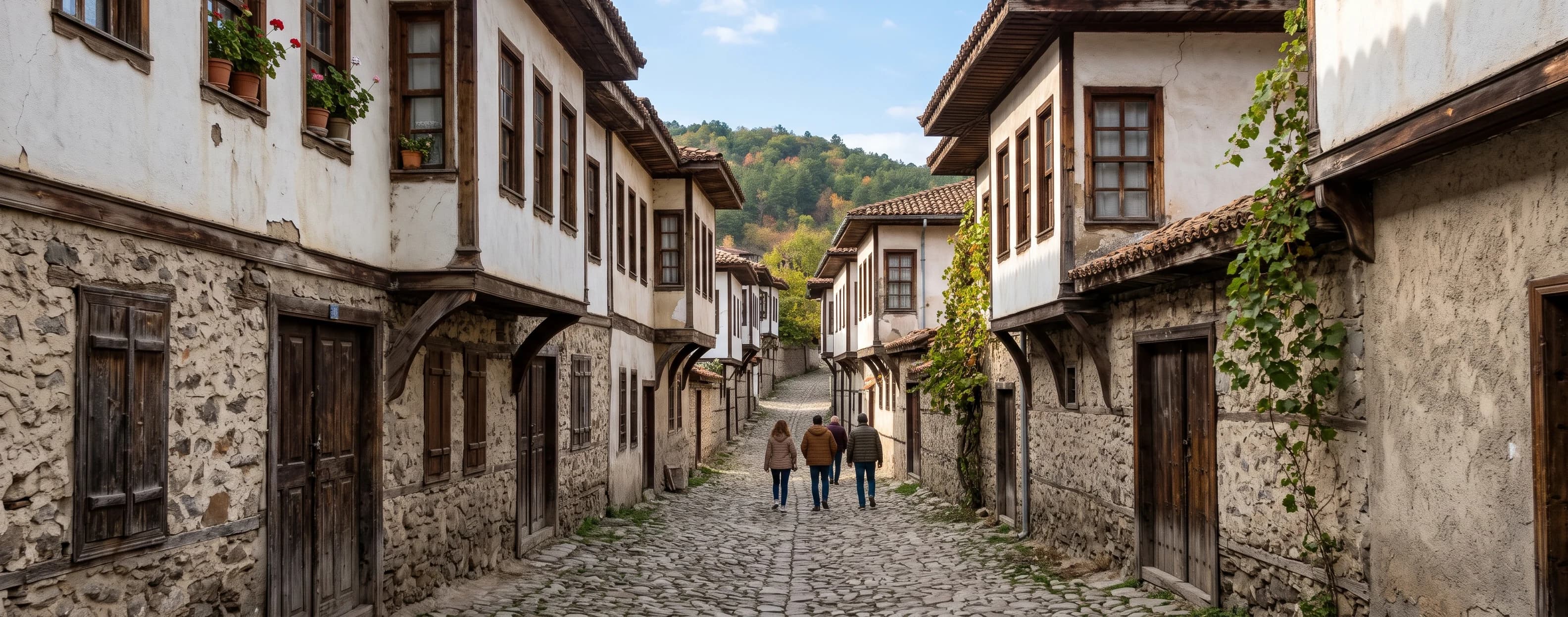
Karabük
Karabük is a small province in northern Turkey, located between Ankara and the western Black Sea coast. Its capital grew around one of the country's first iron and steel works, but most travelers come for Safranbolu, a hillside Ottoman town about 8 kilometers north. Listed by UNESCO in 1994, Safranbolu preserves hundreds of timber-framed mansions, a 17th-century caravan inn, and lanes of workshops selling copper, crafts, and saffron-flavored Turkish delight. Beyond the old town, the province offers a glass viewing terrace above a canyon, a show cave, the ancient mosaics of Hadrianopolis, and the deep forests around Yenice.
Let the activities begin!
No tours match these filters yet. Try another destination or browse all tours.
Safranbolu, an Ottoman Town on the Caravan Route
For centuries, Safranbolu was a stop on the caravan road between Istanbul and the Black Sea port of Sinop. Merchants, artisans, and officials who prospered from that trade built large family houses here. When railways took over long-distance trade in the early 20th century, the town's fortunes declined, and its old fabric stayed largely intact. In 1994, UNESCO inscribed the City of Safranbolu as a World Heritage Site, citing it as a typical Ottoman city that has kept much of its original character. Around 2,000 historic houses remain, and several hundred are officially protected.
Most houses share a familiar design: a stone ground floor, timber-framed upper stories finished in white plaster, upper rooms projecting over the street, and red-tiled roofs. Families once split the year between winter homes packed into the valley around the old market, known as Çarşı, and summer homes set in gardens in the higher Bağlar district. Many mansions now serve as guesthouses, so sleeping in one is part of the experience.
Walking the Old Town
Safranbolu is best explored on foot, starting from the main square below the Cinci Han. Built in the 1640s, this large stone caravanserai has about 60 rooms around a courtyard and now operates as a hotel. Its roof offers a fine view over the old town. The Cinci Hamam, a bathhouse from the same century, stands nearby. A short walk away, the Köprülü Mehmet Pasha Mosque dates to 1661 and has a sundial in its courtyard.
Beside the mosque, the Yemeniciler Arastası, a covered lane where shoemakers once worked, is now lined with small craft and souvenir shops. Across the stream, metalworkers still hammer away in the Blacksmiths' Bazaar. To see inside a traditional mansion, visit the Kaymakamlar Evi, a house museum with period furniture, clothing, and kitchenware. Then climb to the yellow former government building, now the City History Museum, and the 18th-century clock tower beside it. Continue up to Hıdırlık Hill for a view across the whole valley, best in the late afternoon.
Saffron and Turkish Delight
The town takes its name from saffron, the costly spice made from the red threads of a purple crocus. Farmers around Safranbolu still grow it on a small scale. The bulbs are planted in late summer, and the flowers open from October into November, when visitors come to watch the harvest and the town holds its annual Saffron Festival. Each flower holds just three red threads, and roughly 150 to 170 blooms are needed for a single gram.
Safranbolu is also well known for lokum, or Turkish delight, sold in many flavors in shops around the market, including versions colored and scented with saffron. Look out for local helva and baklava too, as well as copper pots and carved wooden pieces in the bazaar lanes.
Yörük Village, Canyons, and Caves
About 11 kilometers east of Safranbolu, Yörük Village (Yörükköy) feels like a smaller, quieter version of the old town. It has been protected since 1997, with 93 of its buildings registered. Its lanes of old family houses make an easy half-day outing.
North of town, the İncekaya Aqueduct spans the steep Tokatlı Canyon. Nearby, the Crystal Terrace, a glass-floored viewing platform built in 2012, juts out about 80 meters above the canyon floor. A path also leads down into the gorge for a walk of around 2 kilometers. Farther north is the Bulak Mencilis Cave, a long cave system with a section of about 500 meters open to visitors.
Hadrianopolis and Its Mosaics
Near Eskipazar, in the south of the province, lie the ruins of Hadrianopolis. People lived here from the 1st century BC, and the city took the name of Emperor Hadrian in the 2nd century AD. Excavations began in 2003 and have uncovered baths, churches, a theater, and defensive walls. The floor mosaics have earned the site the nickname "Zeugma of the Black Sea," after the famous mosaic city in Gaziantep. One church floor shows the four rivers of Paradise, and other panels feature birds, deer, and other animals. Several restored buildings are open to visitors, with walking paths and a visitor center.
Karabük, Turkey's Steel Town
Karabük itself is a young city. In the 1930s, it was little more than a hamlet belonging to Safranbolu until the new Turkish Republic chose it as the site of a state iron and steel works. Construction began in 1937, and production started in 1939. The plant, now run by the company Kardemir, still shapes the city. Karabük became a district center in 1953 and a province in 1995. It is also home to Karabük University. Most visitors pass through on the way to Safranbolu, but the city is the region's main transport hub.
Forests and Canyons Around Yenice
West of Karabük, the Yenice district is covered in old, dense forest that forms part of one of Europe's most biologically diverse areas. Its best-known walk follows Şeker Canyon, a gorge about 6.5 kilometers long cut by a clear stream. The Ihlamur Terrace, named for the surrounding linden trees, adds viewing platforms, walking paths, a café, and a small plant museum. Hiking, camping, and nature photography are the main draws here.
Getting There and Around
Safranbolu lies about 220 kilometers north of Ankara and roughly 400 kilometers east of Istanbul, so most travelers arrive by road. Long-distance buses serve both Karabük and Safranbolu, and local buses and minibuses link the two in about 15 minutes. Karabük also has a station on the Ankara–Zonguldak railway. The nearest airports are Kastamonu, about 90 kilometers away, and Zonguldak Çaycuma, about 100 kilometers away.
The old town is compact but hilly, with steep cobbled lanes. For Yörük Village, the canyons, the cave, Hadrianopolis, or Yenice, having your own transport or joining a guided tour saves a lot of time. Safranbolu combines well with Bolu and its lakes on the road from Istanbul, with Ankara, or with Amasya farther east.
When to Visit
Spring and autumn bring the best conditions for strolling the old town and heading out into the countryside. May and June bring green hills, while October adds the saffron harvest and autumn color in the Yenice forests. Summer afternoons can be hot in the valley, but evenings in the old town are pleasant. Winters are cold and damp, and snow on the tiled roofs gives Safranbolu a quiet, picture-book look, though some outdoor sights are harder to reach.
Allow at least one full day for Safranbolu itself. A two- or three-day stay leaves time for Yörük Village, the canyons, and either Hadrianopolis or Yenice.