
İznik
İznik is a lakeside town in Bursa province, northwest Turkey, built on the site of ancient Nicaea. Few small towns carry so much history. In AD 325, church leaders met here for the First Council of Nicaea, and a second council followed in 787 in the town's Hagia Sophia. Later, İznik gave its name to the Ottoman tiles that decorate many of Istanbul's great mosques. Today, you can walk sections of the Roman and Byzantine walls, visit the Hagia Sophia and the Green Mosque, and see the remains of a basilica in the shallows of Lake İznik. This guide covers the town's history, what to see, and how to get there.
Let the activities begin!
No tours match these filters yet. Try another destination or browse all tours.
Ancient Nicaea and Its Councils
Antigonus, one of Alexander the Great's successors, founded the city in 316 BC at the eastern end of Lake İznik. Under Rome and Byzantium, Nicaea became an important regional center, but its lasting fame comes from two church councils. In 325, Emperor Constantine gathered bishops from across the Roman world for the First Council of Nicaea, the meeting that drafted the first form of the Nicene Creed. In 787, the Seventh Ecumenical Council met in the Hagia Sophia in the city center.
In 1331, the Ottoman ruler Orhan took the city, and for a short time, it served as an early Ottoman capital. The 1,700th anniversary of that first council brought İznik back into the headlines. In November 2025, the Pope and the Ecumenical Patriarch of Constantinople held a joint prayer service beside the lake.
The Hagia Sophia
The Hagia Sophia of İznik stands at the crossroads in the middle of town. Built in the sixth century during Justinian I's reign, it became a mosque once the Ottomans took the town. After a long period in ruins and restoration work that began in 2007, it reopened as a mosque in 2011. Visitors should dress modestly and plan around the daily prayers.
The Lake Basilica
In 2014, aerial photos showed the outline of a large church lying in shallow water near the lakeshore. Archaeologists identified it as a basilica dedicated to Saint Neophytos, an early Christian martyr. It was built in the fourth century and was later destroyed by an earthquake. Excavations began in 2015.
A visitor center beside the site opened in October 2025 and includes a viewing terrace over the ruins, an exhibition hall, a café, and a lakeside walking path. How much of the basilica you can see depends on the water level, so the view changes with the seasons.
City Walls and Gates
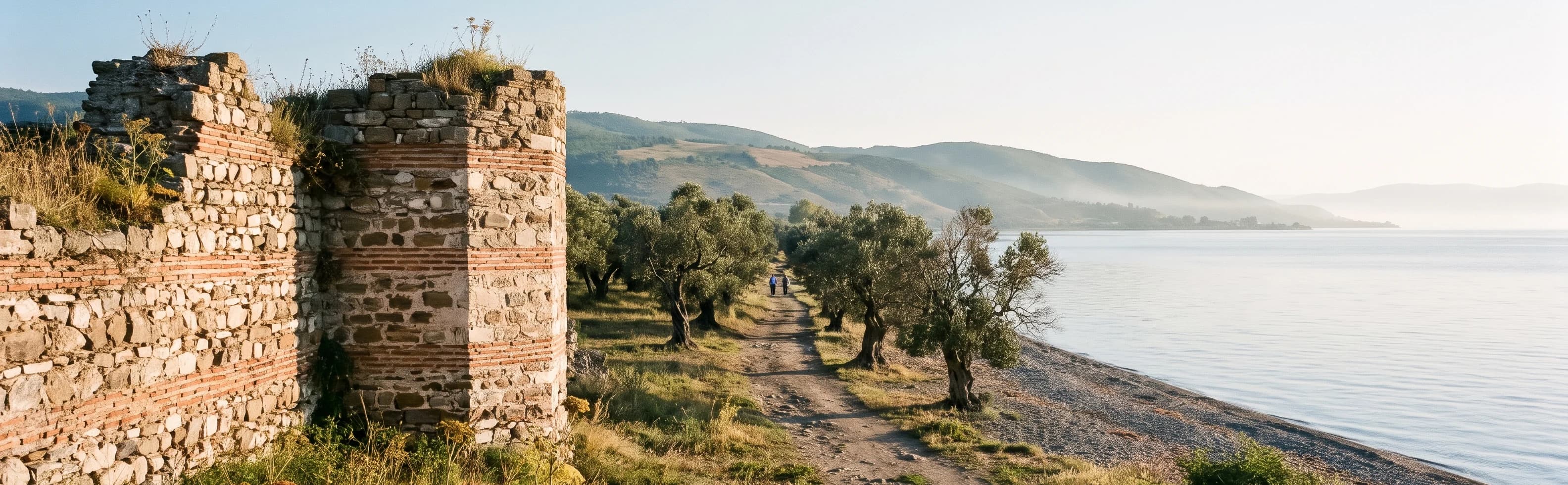
İznik still keeps much of its ancient wall circuit, about 5 kilometers long, with more than 100 towers. Large gates on the land sides were once the city's only entry points. The Lefke Gate in the east and the Yenişehir Gate in the south are among the best places to see them up close. Parts of the walls are ruined, but you can follow long stretches on foot, which is a good way to understand the town's layout.
The Green Mosque, the Museum, and Early Ottoman İznik
Near the Lefke Gate stands the Green Mosque (Yeşil Cami), built in the late fourteenth century for Çandarlı Kara Halil Hayreddin Pasha, the first Ottoman grand vizier. Across the road, Sultan Murad I built the Nilüfer Hatun İmareti in 1388 in memory of his mother; it now serves as a museum. The small Hacı Özbek Mosque, built in 1333, dates to the early years of Ottoman rule.
İznik Tiles
From the fifteenth to the seventeenth centuries, İznik workshops produced some of the finest ceramics of the Islamic world. Their brightly glazed tiles covered the walls of mosques designed by Mimar Sinan in Istanbul. Production declined in the seventeenth century, and only faint traces of the old kilns remain. Today, the best places to see historic İznik tiles are museums and the great Ottoman mosques.
Getting to İznik
İznik is about 80 kilometers by road from Bursa, and minibuses connect the two. From Istanbul, a common route is a fast ferry from Yenikapı across the Sea of Marmara to Yalova, then a bus or minibus to İznik. Drivers can treat İznik as a day out from Bursa or as a handy stop between Istanbul and Bursa. You can see the main sights in a day, but staying overnight means you can stroll by the lake once the town quiets down.