
Demre
Demre is a farming town on the Lycian coast of Antalya province, about 145 kilometers southwest of Antalya city. The town occupies the site of ancient Myra, once a principal city of the Lycian League and later the see of Saint Nicholas, the fourth-century bishop who inspired Santa Claus. Visitors come for the house-shaped Lycian tombs carved into the rock face, the large Roman theater below, and the Church of St. Nicholas in town. On the coast, the ruins of Myra's harbor at Andriake include a Roman granary, and boats leave nearby for the sunken ruins of Kekova. Read on for what to see, the old harbor, and practical advice for a day in Demre.
Let the activities begin!
No tours match these filters yet. Try another destination or browse all tours.
Myra's Rock Tombs and Roman Theater
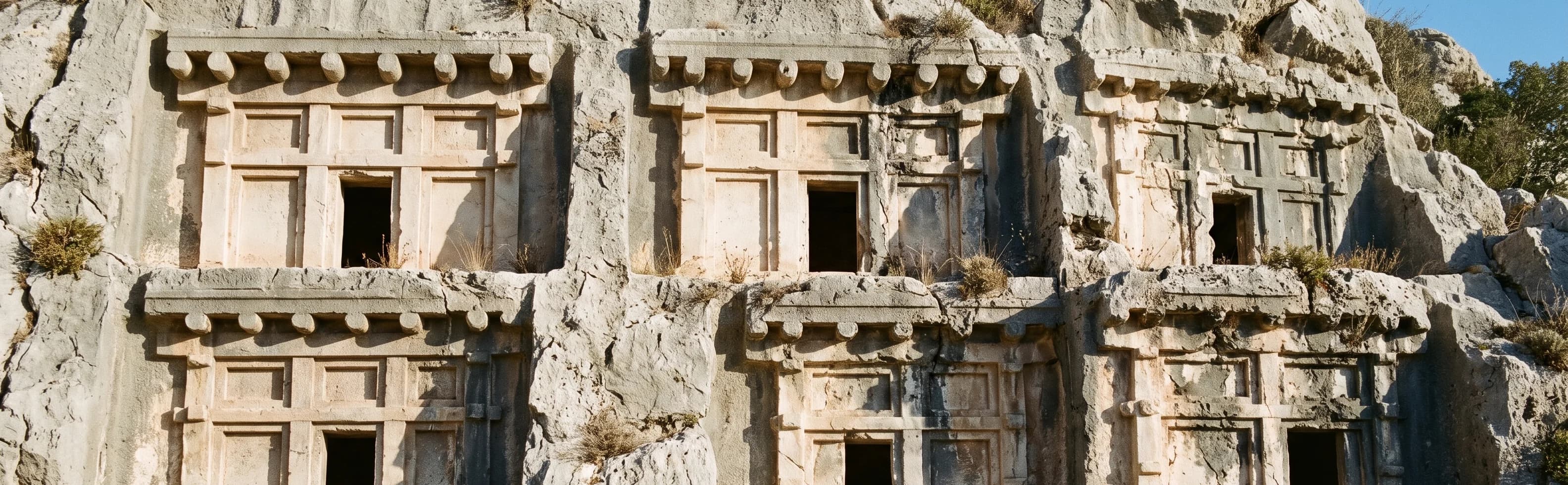
People had settled at Myra by the fifth century BC, and it rose to become one of the six leading members of the Lycian League, each holding three votes in the league's assembly. Its best-known remains are the rock-cut tombs on the cliff above the theater, at the edge of the modern town. Most date from the fourth century BC and follow the Lycian house-tomb style, with façades carved to copy timber buildings, down to the beams, panels, and doorways.
The tombs fall into two main groups. The sea necropolis climbs the cliff beside the theater, while the river necropolis lies farther east, on a rock face overlooking the stream valley. A few of its tombs carry figures carved in relief, including the so-called Painted Tomb and the Lion Tomb.
The theater below was rebuilt in Roman times over an earlier Hellenistic one. It is the largest in Lycia, with seats for around 10,000 spectators, and much of its stage building still stands. Excavations at Myra have continued since 2009. A restoration of the theater is planned, so parts may be closed behind barriers during the work.
The Church of St. Nicholas
Nicholas was bishop of Myra in the fourth century. Stories of his secret gifts to the poor and his care for sailors and children spread across the Christian world, and over many centuries his legend shaped the figure of Santa Claus. He was buried in Myra, and for centuries afterward pilgrims came to his tomb.
The church you see today grew over several building phases on the site of an earlier church. It was enlarged in the sixth century and repaired in the eleventh century after raids from the sea. Inside are faded frescoes, including the only cycle of scenes from the saint's life in Turkey, and a broken marble sarcophagus in the south aisle that tradition links to his burial. In 1087, sailors from Bari in southern Italy carried most of his bones to their city, where they remain today.
Over time, river silt buried the building, and it now sits below the level of modern streets. Russian patrons paid for restoration work in the mid-nineteenth century, and archaeologists have excavated the church since the late 1980s. On December 6, the saint's feast day, an Orthodox liturgy is sometimes held here.
Andriake, Myra's Ancient Harbor
Myra's port lay at Andriake, a few kilometers southwest of the town, beside today's Çayağzı beach. Saint Paul, as told in the Book of Acts, changed ships at Myra on his voyage to Rome, boarding a ship from Alexandria bound for Italy. The largest building on the site is the granary built under Emperor Hadrian in the second century AD. Restored in 2016, it houses the Lycian Civilizations Museum, with finds from Myra and other Lycian cities such as Patara and Xanthos. The museum closed in early 2025 for new displays and landscaping. Confirm it is open again before you plan a visit.
Around the granary, paths lead past the harbor agora with a large cistern beneath it, as well as bathhouses, churches, and remains of a synagogue. Excavations in the agora uncovered a workshop that made purple dye from murex sea snails in late antiquity. The old harbor has long since silted up, and the reed beds along the stream now attract many birds.
Boat Trips to Kekova
Çayağzı, next to Andriake, is a small harbor where many boats leave for Kekova, and others start from Üçağız farther west. A typical day on the water passes the half-submerged ruins along Kekova Island's shore; swimming above the remains is forbidden. Most trips also stop at Kaleköy, the ancient Simena, where a castle stands on the hill above the bay, and pause in quieter coves for a swim. A popular day out from Antalya pairs Myra and the church in the morning with a Kekova boat in the afternoon.
Demre Beyond the Ruins
Away from the archaeological sites, Demre is a working agricultural town. The flat plain around it, built from river silt, is covered in greenhouses growing tomatoes and other vegetables for much of the year. The beach at Çayağzı is a quiet place to swim after a morning of sightseeing.
Planning a Visit to Demre
Demre lies on the coast road between Kaş to the west and Finike to the east. From Antalya, the drive of about 145 kilometers takes roughly three hours, past the resort area around Kemer and along the mountainous Lycian coast. Many visitors arrive on an excursion from Antalya, while others break a longer drive along the coast here. One full day covers Myra, the church, and either Andriake or a Kekova boat trip. Staying a night in Demre or nearby Kaş lets you see everything at a more relaxed pace.
Myra, the Church of St. Nicholas, and Andriake are state-run sites with separate entrances. Expect uneven ground and strong sun at Myra and Andriake. Good shoes, sun protection, and a full water bottle make the visit easier.